
7 Smart Landscape Lighting Features to Consider
Table of Contents
- Solar vs. Low-Voltage Landscape Lighting
- Best Low-Voltage Outdoor Lighting Fixtures for Smart Systems
- Smart Outdoor Lighting Automation and Scheduling
- Smart Home Integration for Landscape Lights
- RGB Color-Changing Capabilities and Brightness Control
- Weather Resistance, Connectivity, and Cybersecurity
- Troubleshooting Connectivity Issues and Maintenance
- Conclusion
- Frequently Asked Questions
Last Updated: September 19, 2026
Solar vs. Low-Voltage Landscape Lighting
When choosing between solar and low-voltage systems, the decision comes down to performance, reliability, and your specific outdoor space. Low-voltage landscape lighting features offer significantly more control, brightness, and integration capabilities than solar alternatives.
Solar lights rely on battery storage from daytime sun exposure and struggle in cloudy climates, shade, and winter months. Battery performance degrades over time, limiting brightness.
Low-voltage systems connect to a transformer that steps down standard household power to 12 volts. This approach delivers consistent, bright illumination regardless of weather or season. Low-voltage fixtures integrate seamlessly with smart home automation, allowing scheduling, dimming, and color control. Paramount Outdoor Lighting Group specializes in expertly crafted low-voltage lighting systems.
Installation requires underground wiring and transformer placement, but professional installation ensures proper voltage drop calculations and safe wire gauge selection. Once installed, low-voltage systems operate reliably for decades with minimal maintenance.
For homeowners seeking smart landscape lighting features with consistent performance, low-voltage is the superior choice. It enables the automation, scheduling, and smart home integration that solar cannot match.
Best Low-Voltage Outdoor Lighting Fixtures for Smart Systems
Smart landscape lighting features work best with the right fixture types. Low-voltage systems support multiple fixture styles, each serving a specific purpose in your landscape design.
Path lights mark walkways and garden edges at 12-18 inches tall, creating safe passage and subtle ambient lighting.
Spotlights direct light upward or at angles to highlight trees, architectural details, and focal points, delivering dramatic accent lighting with maximum visual impact.
Well lights sit flush in the ground and point upward to illuminate plantings and create uplighting effects, remaining invisible during the day.
Flood lights spread light across larger areas for security lighting and broad hardscape illumination.
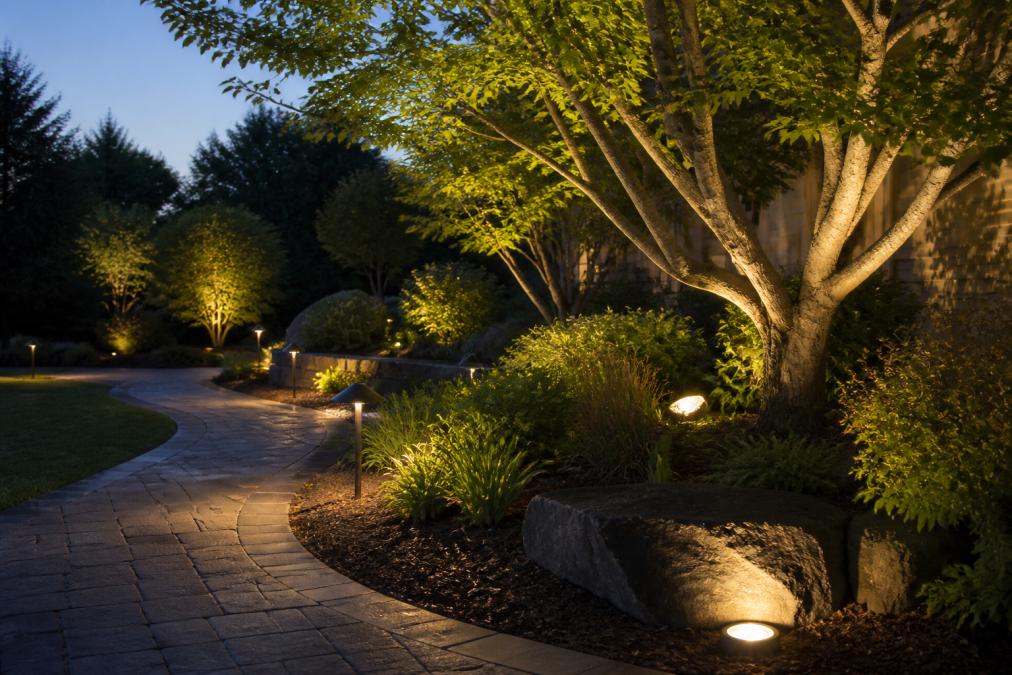
Each fixture type connects to the same transformer and control system, allowing you to mix types throughout your property and manage all from a single smart hub.
Smart automation lets you schedule lights individually, create scenes like "entertaining" or "security," and adjust brightness from your phone.
Smart Outdoor Lighting Automation and Scheduling
Smart landscape lighting features include built-in dusk-to-dawn sensors that activate lights automatically at sunset and deactivate at sunrise, eliminating manual control and saving energy.
Custom routines let you dim lights to 30% for entertaining, then increase to full brightness at 10 PM for security, with different schedules for weekdays and weekends.
Motion-activated lighting pairs motion sensors with spotlights for security, activating instantly to deter unwanted activity without leaving lights on constantly.
Smart home integration connects your landscape lighting to voice assistants and automation platforms, triggering multiple fixtures simultaneously for entertaining or security.
Smart automation adapts to your lifestyle, adjusting lighting automatically based on your patterns without manual intervention.
Smart Home Integration for Landscape Lights
Smart home integration connects your outdoor lighting to the same ecosystem managing your indoor smart home, simplifying control and creating powerful automation possibilities.
Connectivity Protocols and Range
Most systems use Wi-Fi or Zigbee connectivity. Wi-Fi offers broader range and faster response, but outdoor distance causes dropouts. Zigbee uses mesh networking where each device relays the signal, extending range without relying on a single access point and consuming less power.
For properties larger than 50 feet from your router, Zigbee mesh systems typically outperform Wi-Fi. If you choose Wi-Fi, add a Wi-Fi 6 mesh system with outdoor-rated nodes for landscape lighting control.
Platform-Specific Workflows and Voice Routines
Your smart hub becomes the command center. Popular platforms include Amazon Alexa, Google Home, and Apple HomeKit, each offering different automation depth.
Amazon Alexa excels at routine creation. Build a "Goodnight" routine that dims landscape lights to 20%, activates motion sensors, and turns lights off at midnight. Routines trigger based on time, voice commands, or device states like door lock engagement.
Google Home creates scenes that activate multiple lights simultaneously, triggered by time, location (geofencing), or voice command. Say "Hey Google, movie time" to dim landscape lights to 10%.
Apple HomeKit processes automations locally on your HomePod or Apple TV, so lighting automations work even if your internet drops. Automations trigger based on time, location, or sensor input.
Voice control adds convenience during outdoor entertaining, letting you adjust lights without finding your phone.
Advanced Automation Scenarios
Integration with door sensors activates lights when someone approaches your entrance. Connect to weather data so lights adjust brightness on cloudy days. Link to your security system so outdoor lights activate at full brightness when motion is detected after sunset.
Create a "Leaving Home" routine with random lighting patterns to simulate occupancy and deter break-ins. Set an "Arriving Home" routine that gradually brightens path lights as you approach.
Cybersecurity and Network Safety
Choose systems from manufacturers who use encrypted connections (TLS 1.2 or higher), release firmware updates at least quarterly, require strong authentication with unique passwords, and have a published security update policy. Avoid older systems that no longer receive security patches. Use a separate Wi-Fi network (guest network) for outdoor smart devices if your router supports it.
Testing Integration Before Full Installation
Before committing to a full system, purchase a single smart outdoor light fixture and test it for one week. Verify voice commands work reliably, automations trigger as expected, and the device maintains connection in different weather.
RGB Color-Changing Capabilities and Brightness Control
RGB color-changing capabilities let you customize your outdoor lighting to match any mood or occasion, creating millions of color options.
Brightness is measured in lumens: 100-300 for accent lighting, 50-150 for pathways, and 500+ for security lighting across larger areas.
Color temperature affects landscape feel: warm white (2700K) creates inviting ambiance, cool white (4000K-5000K) feels energetic.
Weather Resistance, Connectivity, and Cybersecurity
Outdoor lighting faces harsh conditions from rain, snow, temperature swings, and UV exposure. Weather resistance ratings determine system lifespan.
Troubleshooting Connectivity Issues and Maintenance
Diagnosing Connectivity Problems
Extending Signal Range for Outdoor Lighting
Wi-Fi Range Extension: Move your smart hub closer to a window facing your outdoor lighting area. If that's not possible, add a Wi-Fi 6 mesh node between your main router and outdoor lights. Mesh systems create a seamless network where outdoor lights automatically connect to the strongest node.
Reducing Interference
Sensor-Specific Troubleshooting
Scheduled Lights Not Activating
Color-Changing Lights Showing Wrong Colors
Regular Maintenance Schedule
| Maintenance Task | Frequency | Impact |
|---|---|---|
| Clean sensor lenses | Quarterly | Prevents missed motion detection and dusk-to-dawn failures |
| Check wiring for exposure | Quarterly | Avoids water damage and corrosion |
| Trim vegetation around sensors | Quarterly | Maintains clear line of sight for motion and light sensors |
| Replace wireless batteries | Annually or when app indicates low | Maintains reliable connectivity |
| Update firmware | As available (check monthly) | Improves security, performance, and fixes bugs |
| Inspect connections for corrosion | Annually | Prevents power loss and intermittent failures |
| Test voice commands | Monthly | Catches connectivity drift before it becomes a problem |
Conclusion
Smart landscape lighting features transform how you experience your outdoor spaces. Low-voltage systems with automation, scheduling, smart home integration, and proper maintenance create systems that are both beautiful and functional.
Frequently Asked Questions
What are the key differences between low-voltage and smart landscape lighting?
Low-voltage landscape lighting uses a transformer to reduce standard household voltage to 12 volts, making it safer and more energy-efficient for outdoor use. Smart landscape lighting adds automation capabilities, allowing you to control brightness, color temperature, and scheduling through Wi-Fi, Bluetooth mesh, or Zigbee connectivity. Smart systems let you adjust your outdoor lighting remotely or set dusk-to-dawn sensors and motion-activated features. Both approaches work together, most smart landscape systems are built on low-voltage foundations for safety and efficiency.
Can smart landscape lighting be integrated with existing home automation systems?
Yes, most modern smart landscape lighting systems integrate with popular smart home platforms through Wi-Fi connectivity or mesh networks like Zigbee and Bluetooth mesh. This allows you to control your outdoor lights alongside interior smart devices, set unified automation routines, and even trigger lighting based on voice commands through compatible voice assistants. Before purchasing, verify that the system supports your existing smart home hub or platform. Professional installation ensures proper network configuration and security protocols are in place.
Are smart landscape lighting systems energy efficient?
Smart landscape lighting systems are highly energy-efficient, especially when built on LED technology and low-voltage infrastructure. LED fixtures consume 80% less energy than traditional halogen bulbs and last significantly longer. Smart automation features enhance efficiency further by allowing you to schedule lights to run only when needed, adjust brightness based on ambient conditions, and eliminate wasted illumination. Low-voltage systems reduce energy loss through voltage drop, and dusk-to-dawn sensors prevent lights from running during daylight hours.
What weather-resistant features should I look for in smart outdoor lighting?
Look for fixtures rated IP65 or higher, which provide protection against dust and water jets from any direction. Check that all outdoor components, including transformers and connection points, are weatherproof and designed for exposure to rain, snow, and temperature fluctuations. Stainless steel or powder-coated aluminum housings resist corrosion. Ensure cables are buried properly or protected in conduit to prevent water damage. Regular maintenance of sensors and connection points helps prevent weather-related connectivity issues.
Ready to enhance your property with smart landscape lighting? Request a walk-through consultation with Paramount Outdoor Lighting Group and see how professional outdoor lighting design transforms your home's curb appeal and functionality.