Custom Outdoor Lighting for Small Restaurant Patios
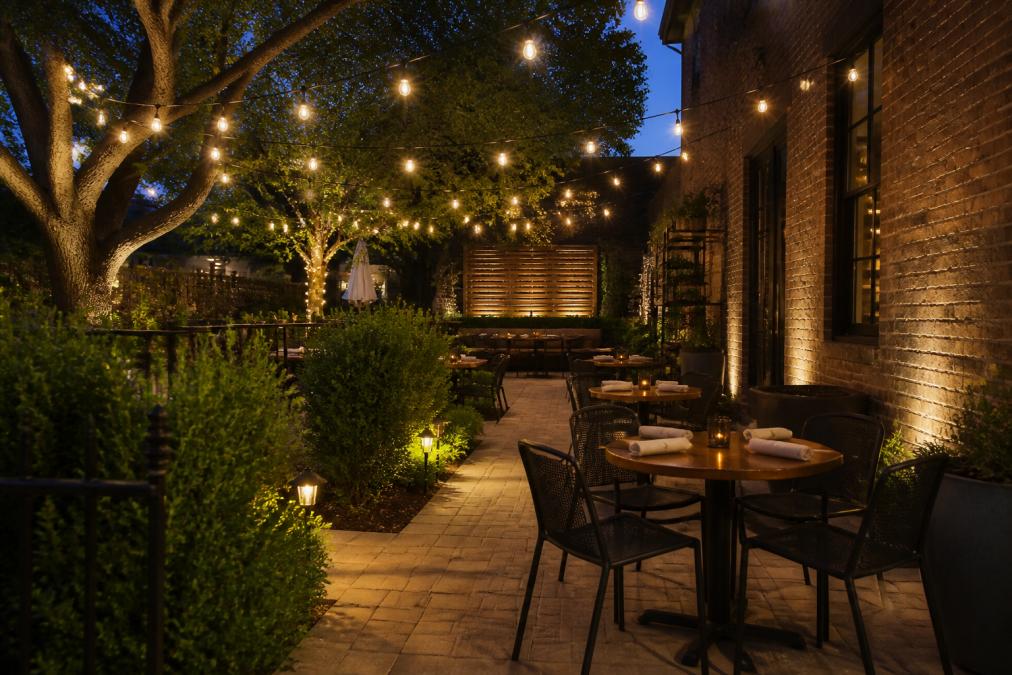
Table of Contents
- Why Restaurant Patio Lighting Directly Affects Your Revenue
- Outdoor Patio Lighting Design Best Practices for Tight Spaces
- Commercial Bistro String Lights Installation on Small Patios
- Commercial Outdoor Lighting Safety Standards You Must Meet
- Custom Restaurant Patio Lighting: ROI for Small Spaces
- Energy Efficiency: LED Technology and Fixture Durability
- DIY vs. Professional Installation for Commercial Patios
- Conclusion
Last Updated: August 21, 2026
Why Restaurant Patio Lighting Directly Affects Your Revenue
Custom outdoor lighting for small restaurant patios is one of the highest-return investments a restaurant owner can make. Lighting is not decoration, it is a revenue mechanism. The right setup extends your seating hours into the evening, makes a cramped patio feel intentional and intimate, and signals quality to passersby. The wrong setup signals the opposite.
According to the National Restaurant Association's guidance on outdoor dining, outdoor seating is one of the most requested amenities by diners, and patio ambiance drives table turns, average check size, and repeat visits. The good news: you don't need a large patio to benefit. Small spaces, designed correctly, often outperform larger ones because every lighting element is visible from every seat.
Outdoor Patio Lighting Design Best Practices for Tight Spaces
The biggest mistake with small patio lighting is treating the space like a miniature version of a large one. Tight spaces require a fundamentally different design logic, where every fixture does double duty and nothing competes for visual attention.
The foundation of good design is the three-layer system: ambient, accent, and task. Skipping any one produces either a flat, overlit space or a moody one that's hard to eat in.
Layering Ambient, Accent, and Task Lighting
Ambient lighting is the base layer, general illumination that defines mood. For small patios, overhead canopy string lights or a low-voltage perimeter soffit system typically handle this. The goal is even, diffuse light that eliminates harsh shadows.
Accent lighting adds depth and visual interest. Direct low-wattage spotlights at a brick wall, planter, or architectural detail. This creates the perception of a larger, more layered space, a genuine advantage on a tight footprint.
Task lighting covers functional zones: enough lumens at table height for guests to read a menu comfortably. Many operators rely entirely on ambient overhead light, which falls short at table level. A targeted low-voltage fixture mounted at fence height solves this without clutter.
The rule: every fixture should serve at least two of these three functions, or it's taking up visual real estate it hasn't earned.
Color Temperature: Choosing the Right Kelvin Range
Color temperature, measured on the Kelvin scale, is often misunderstood. For outdoor dining, the sweet spot is 2700K to 3000K. Warm white light makes food look appealing, flatters skin tones, and creates intimacy that keeps guests lingering, directly increasing average check size. Cool white light above 4000K reads as clinical and institutional.
If you're mixing fixture types, match their color temperatures within 200K of each other. Mismatched temperatures create visual inconsistency that guests notice.
Commercial Bistro String Lights Installation on Small Patios
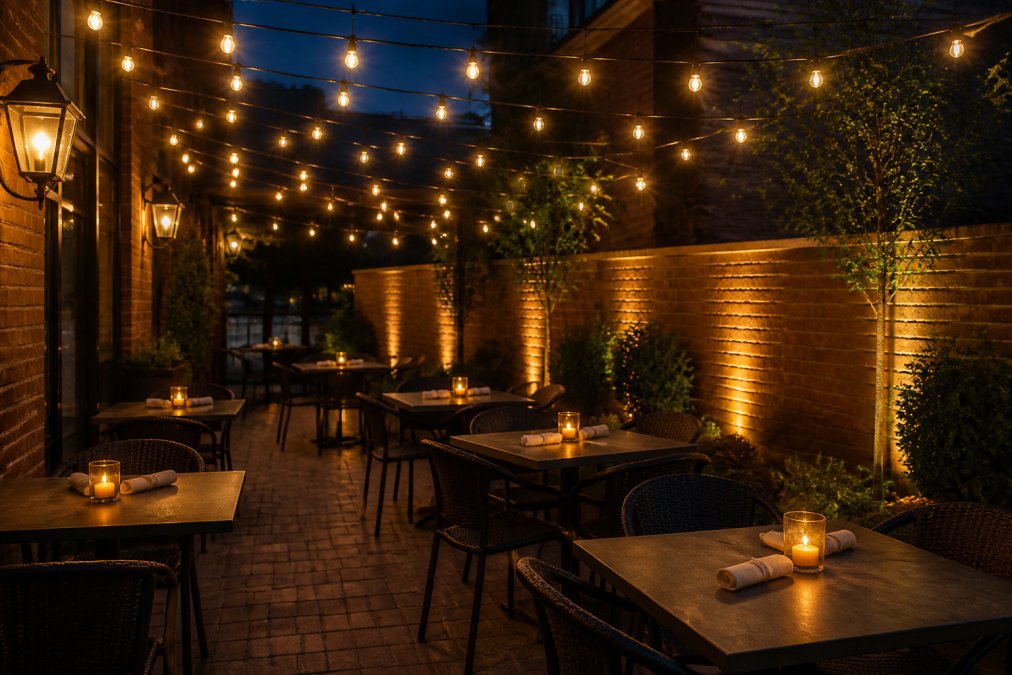
Commercial bistro string lights installation is where most small restaurant patios start. Overhead string lights create an immediate canopy effect that makes a space feel defined without requiring permanent structural build. But the word "commercial" matters enormously.
Consumer-grade string lights fail faster and aren't rated for continuous outdoor commercial use. Commercial-grade string lights use heavier-gauge wire, weatherproof bulb sockets, and connectors rated for outdoor exposure.
Overhead Canopy Patterns That Save Space
The canopy pattern determines how much overhead space you consume and how light distributes across the patio. For small patios, three patterns work best:
- Parallel runs: Lines run from one wall or post to another. Most space-efficient for rectangular patios under 300 square feet.
- Catenary V-pattern: Lines run from a central anchor point to the perimeter, creating a tent effect. Draws the eye upward and makes low-ceiling patios feel taller.
- Grid pattern: Lines run in both directions, crossing overhead. Maximizes lumens at table level but requires more anchor points.
The anchor infrastructure is critical. If your perimeter walls or posts can't support the tension load of commercial string lights, you need intermediate poles or a cable suspension system.
Low-Voltage Wiring and Avoiding Voltage Drop
Low-voltage lighting systems, typically 12V, are the standard for commercial outdoor patio installations because they're safer, more energy-efficient, and easier to modify than line-voltage systems. However, low-voltage systems face a specific challenge: voltage drop.
Voltage drop is the reduction in electrical voltage as current travels along a wire. On patios where string lights run 60 or more feet from the transformer, fixtures at the far end can receive noticeably less voltage, producing dimmer light than fixtures near the transformer. small patio design ideas.
The fix: use a hub-and-spoke wiring topology rather than daisy-chain, and size your wire gauge to the run length. A 12-gauge wire handles longer runs than 14-gauge without meaningful voltage drop. Your installer should calculate the load and run length before specifying wire gauge.
Commercial Outdoor Lighting Safety Standards You Must Meet
Commercial outdoor lighting safety standards are not optional. Getting this wrong creates liability exposure that no small restaurant can afford.
The primary standards governing commercial outdoor lighting installations in the United States are the National Electrical Code published by NFPA and local municipal building codes. Key compliance requirements for restaurant patios:
- GFCI protection: All outdoor receptacles and lighting circuits in wet or damp locations must be protected by ground-fault circuit interrupters.
- IP ratings: Fixtures must carry an appropriate Ingress Protection rating for their exposure. Fixtures directly exposed to rain require at minimum IP65; fixtures in covered but open-air locations can use IP44.
- Wet vs. damp location ratings: The NEC distinguishes between wet locations (direct rain exposure) and damp locations (sheltered but humid). Using a damp-rated fixture in a wet location is a code violation.
- Permit requirements: Most municipalities require a permit for new commercial outdoor electrical work. Operating without a permit can void your property insurance.
Custom Restaurant Patio Lighting: ROI for Small Spaces
The ROI case for custom outdoor lighting runs through three channels: extended operating hours, increased average check size, and reduced energy costs.
A patio unusable after sunset is a revenue gap that occurs every night. Lighting that extends outdoor dining into the evening, even by 90 minutes per night, adds meaningful covers to the weekly total. In shoulder months like April, May, September, and October, a well-lit patio can remain operational on nights that would otherwise push all guests inside.
According to Cornell's Center for Hospitality Research on restaurant environment, ambient conditions including lighting directly influence how long guests stay and how much they spend. Warmer, lower-intensity lighting correlates with longer dwell times and higher beverage sales.
Shoulder Hours and Dimmable Smart Controls
Dimmable LED fixtures controlled by a smart lighting system let you set different scenes for different dayparts without manual adjustment. A brighter setting for the 5pm-7pm early dinner crowd. A dimmer, more intimate scene for the 9pm-11pm late-night crowd. These calibrated settings influence guest behavior and increase revenue.
Smart controls also enable scheduling and remote management. If an event runs long, you can extend the lighting from your phone rather than leaving staff to manage it manually.
| Channel | Mechanism | Typical Impact |
|---|---|---|
| Extended hours | Usable patio after sunset | More covers per night |
| Dwell time | Warm ambiance slows table turns productively | Higher beverage sales |
| Energy savings | LED vs. incandescent or halogen | Lower utility costs |
| Reduced maintenance | Commercial-grade fixtures | Fewer replacements |
| Curb appeal | Visible patio ambiance from street | Increased walk-in traffic |
Energy Efficiency: LED Technology and Fixture Durability
LED technology has made the energy efficiency argument for commercial outdoor lighting self-evident. LED fixtures use a fraction of the wattage of incandescent or halogen alternatives while producing equivalent or superior lumens output.
More importantly for commercial applications, commercial-grade LED fixtures are rated for tens of thousands of hours of operation. Many carry L70 ratings of 50,000 hours or more, meaning they'll maintain at least 70% of their initial lumen output for that duration. Fixture durability also reduces your maintenance burden and service interruptions.
DIY vs. Professional Installation for Commercial Patios
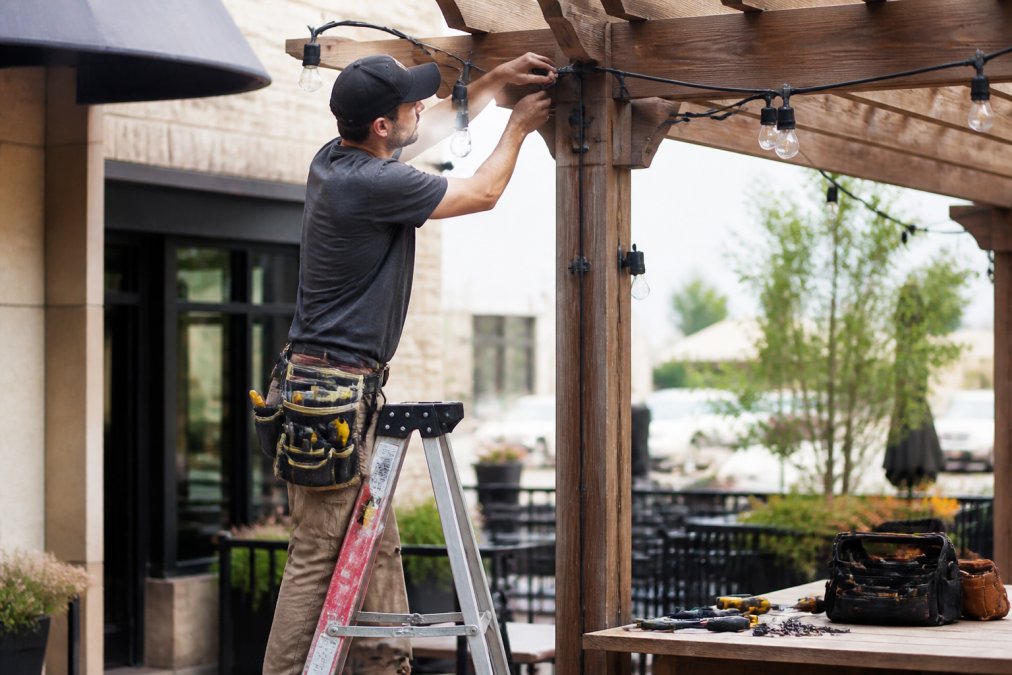
For any installation involving new electrical circuits, permit requirements, or commercial-grade structural anchoring, professional installation is the right call. Commercial outdoor electrical work in most jurisdictions requires a licensed electrician to pull permits and sign off on the installation.
Where DIY makes sense:
- Seasonal decorative lighting plugged into existing commercial-grade exterior outlets
- Replacing fixtures on an existing permitted system with equivalent-rated units
- Repositioning portable fixtures that don't require new wiring
Where professional installation is required:
- New circuits or additional load on existing circuits
- Any work requiring a permit under local code
- Structural anchor installation for overhead canopy systems
- Smart control system integration with the building's electrical panel
The practical approach for small restaurant operators is professional design and installation for permanent infrastructure, with flexibility to add or adjust seasonal decorative elements yourself within that framework.
Small restaurant patios face a real challenge: creating an inviting, functional outdoor dining space within a tight footprint. Paramount Outdoor Lighting Group designs and installs custom outdoor lighting for small restaurant patios with the precision that a tight space demands, from low-voltage system design and commercial-grade fixture specification to smart controls that extend your revenue into shoulder hours. Request a walk-through with our team and get a lighting plan built for your specific space.
Frequently Asked Questions
What are the best lighting options for small restaurant patios?
Commercial bistro string lights work exceptionally well on small patios because they define the space overhead without consuming floor area. Pair them with low-voltage accent lighting on walls or planters and dimmable task lighting over each table. Warm white LEDs in the 2700K-3000K range on the Kelvin scale create inviting patio ambiance without feeling harsh. The key is layering all three types so the space reads as intentional and welcoming after dark.
Are there specific safety codes for commercial outdoor restaurant lighting?
Yes. Commercial outdoor lighting for restaurants must comply with the National Electrical Code (NEC), local municipal electrical permits, and OSHA standards for workplace safety. Fixtures used in wet or exposed locations must carry an appropriate IP rating. String lights and low-voltage systems must be installed by or inspected by a licensed electrician in most jurisdictions. Pathway lighting and exit routes also need to meet minimum footcandle levels under local fire and building codes.
How can custom restaurant patio lighting increase revenue?
Well-designed restaurant patio lighting extends usable dining hours into the evening and through shoulder seasons, adding covers without adding square footage. Studies in the hospitality industry consistently show that patrons stay longer and spend more in atmospherically lit environments. Custom lighting also improves curb appeal and nighttime visibility, drawing walk-in traffic. For a small patio, even one additional table turn per evening can produce a meaningful return on the initial lighting investment over a single season.
What is the difference between residential and commercial-grade outdoor lighting?
Commercial-grade outdoor lighting is built for continuous, high-cycle use across multiple seasons. Fixtures carry higher IP ratings for weatherproofing, use heavier-gauge wiring, and are rated for the wattage demands of a full patio run. Residential products are designed for occasional use and lighter loads, so they fail faster under restaurant conditions. Commercial-grade LED string lights and fixtures also carry UL listings for commercial environments, which matters for insurance coverage and local inspection sign-off.
This article was written using GrandRanker