
Why Professional Lighting Installation Lasts Longer
Table of Contents
- What Makes Professional Lighting Installation Last Longer
- Professional vs DIY Outdoor Lighting: A Side-by-Side Look
- LED Technology, IP Ratings, and Weather Resistance
- Electrical Safety, Load Calculations, and NEC Compliance
- How Climate Affects Outdoor Lighting Longevity
- Outdoor Lighting Maintenance Tips That Extend System Life
- Understanding the Cost of Professional Landscape Lighting Installation
- Conclusion
Last Updated: August 20, 2026
What Makes Professional Lighting Installation Last Longer
Most homeowners don't realize that outdoor lighting failure is almost never about the bulbs. It's about everything behind the bulbs: the wiring, the connectors, the transformer, and the decisions made during installation. Professional lighting installation is the practice of designing, specifying, and deploying outdoor lighting systems using commercial-grade components, engineered load calculations, and installation standards that residential DIY kits simply cannot replicate.
At Paramount Outdoor Lighting Group, we've seen the same pattern repeatedly: a homeowner invests in a DIY system, it looks great for six months, and then the flickering starts. By month eighteen, half the fixtures are dark. The root cause is almost always a combination of undersized components, poor connector sealing, and voltage drop that was never accounted for in the first place.
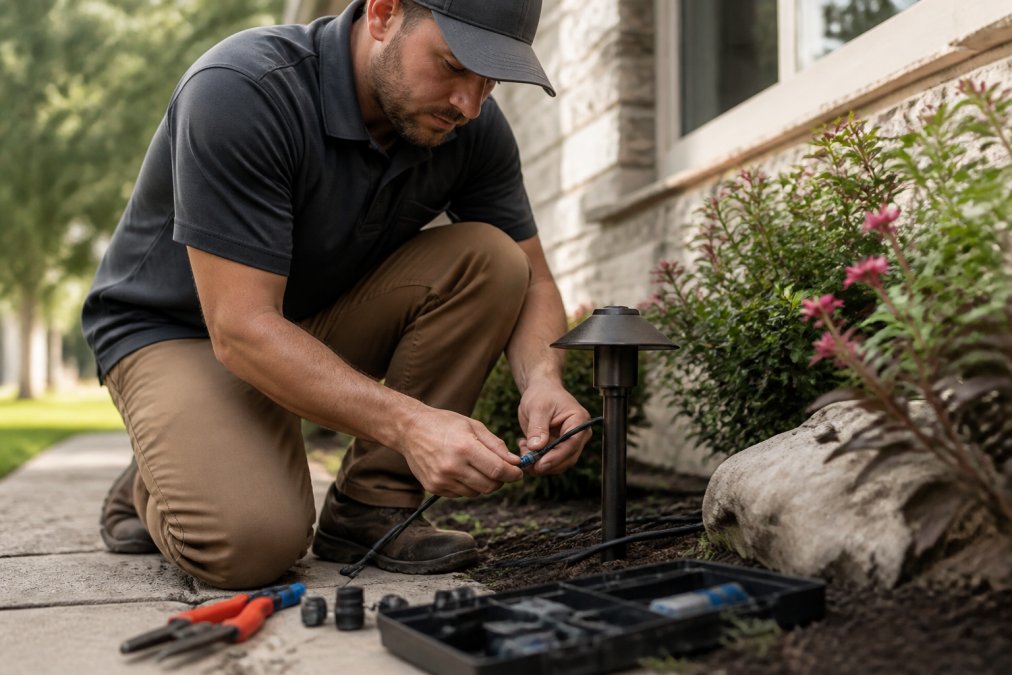
Professional installation addresses these failure points before they become problems. The difference isn't cosmetic. It's structural.
Professional-Grade Components vs. Residential-Grade Materials
The gap between professional-grade and residential-grade outdoor lighting components is significant. Professional systems use UV-rated materials for all exposed wiring and fixture housings, corrosion-resistant brass or copper fixtures rather than painted aluminum, and connectors with silicone or gel-filled seals that maintain wiring integrity through freeze-thaw cycles and moisture exposure.
Residential kits sold at home improvement stores are engineered to a price point, not a performance standard. Their plastic housings become brittle under UV exposure within two to three seasons. Their push-in connectors trap moisture and corrode. Their wire gauge is often too light to handle the electrical load of a full landscape circuit without voltage drop degrading fixture output.
Professional-grade components cost more upfront. That's not a secret. But the system longevity difference is substantial: professional outdoor lighting systems, properly installed and maintained, routinely outlast DIY installations by many years.
How Transformers Protect the Entire System
The transformer is the most underappreciated component in any low-voltage lighting system. A professional-grade transformer does far more than step voltage down from 120V to 12V. It provides circuit protection through built-in breakers, manages electrical load across multiple zones, and compensates for voltage drop across longer wire runs.
DIY transformers are typically rated for a single zone with a fixed output. Professional transformers offer multi-tap outputs, meaning an installer can adjust the voltage delivered to each circuit to compensate for wire length and fixture count. This is critical for system reliability: a fixture receiving 10.5V instead of 12V will produce noticeably less light and experience accelerated LED driver stress.
According to the Illuminating Engineering Society's outdoor lighting standards, proper voltage management is one of the primary factors determining long-term system reliability in low-voltage landscape lighting. Professional installers design around this from the start.
Professional vs. DIY Outdoor Lighting: A Side-by-Side Look
The honest comparison between professional and DIY outdoor lighting comes down to more than cost. System design, component quality, and installation technique all determine how long a system performs at its intended level.
| Factor | Professional Installation | DIY Installation |
|---|---|---|
| Component grade | Commercial/professional-grade | Residential/consumer-grade |
| Transformer quality | Multi-tap, circuit-protected | Single-zone, fixed output |
| Connector sealing | Gel-filled or silicone-sealed | Push-in, moisture-prone |
| Voltage drop management | Engineered per circuit | Rarely calculated |
| IP rating compliance | Specified per environment | Often unverified |
| NEC compliance | Designed in | Homeowner's responsibility |
| System longevity | Many years with maintenance | Often 1-3 years |
| Warranty coverage | Typically included | Limited or none |
The table above isn't meant to discourage DIY entirely. For a small, simple accent project, a consumer kit can work. But for permanent architectural lighting, landscape systems covering a full property, or any installation on a two-story structure, professional installation isn't a luxury. It's the only approach that makes structural sense.
Where DIY Installations Fail First
The most common DIY failure point isn't what most people expect. It's not the fixtures. It's the connectors.
Push-in wire connectors, the kind supplied with most consumer landscape kits, create a mechanical connection that degrades with thermal cycling. Every night-to-day temperature swing expands and contracts the wire slightly. Over dozens or hundreds of cycles, the connection loosens. Moisture enters. Corrosion begins. One fixture dims, then goes dark, then the corrosion travels up the wire and affects the next connection in the circuit.
The second most common failure point is the transformer. Consumer-grade transformers lack the thermal management to handle continuous operation through summer heat. They overheat, trip their thermal cutoff, and either fail permanently or begin cycling on and off unpredictably.
Professional installations use weatherproofing at every connection point, properly sized wire gauge for each circuit's electrical load, and transformers with genuine heat dissipation capacity. These aren't premium upgrades. They're the baseline for a system designed to last.
LED Technology, IP Ratings, and Weather Resistance
LED technology has transformed outdoor lighting, but not all LED fixtures are created equal. The LED driver, the component that converts AC or DC power to the precise current an LED needs, is where quality differences matter most.
IP ratings (Ingress Protection ratings) define a fixture's resistance to solid particles and moisture. For outdoor landscape applications, a minimum IP65 rating is standard practice: fully dust-tight and protected against water jets from any direction. For fixtures near water features, irrigation zones, or in regions with heavy seasonal precipitation, IP67 or IP68 ratings provide submersion protection.
Consumer-grade fixtures often carry IP44 ratings, which protect against splashing water but not sustained exposure. In practice, this means a fixture positioned near a sprinkler head, in a lawn area, or in a low-lying drainage zone will fail prematurely. Professional installers specify fixture IP ratings based on the actual installation environment, not a generic recommendation.
LED technology in professional-grade fixtures also handles heat dissipation differently. Quality outdoor LED fixtures use aluminum heat sinks to draw heat away from the LED chip, extending bulb lifespan significantly. Poorly designed fixtures trap heat, which degrades the LED phosphor and causes the color temperature to shift before the fixture fails entirely.
As documented in ENERGY STAR's outdoor lighting program requirements, certified outdoor LED fixtures must meet specific thermal management and lumen maintenance standards to qualify, providing a useful baseline for evaluating fixture quality.
Electrical Safety, Load Calculations, and NEC Compliance
Professional lighting installation follows the National Electrical Code (NEC), the standard adopted by most jurisdictions governing electrical installations. For low-voltage landscape lighting, this means proper burial depths for direct-burial cable, correct conduit use where wire crosses hardscape, and appropriate circuit protection at the transformer.
Load calculations are where professional installers earn their fee most clearly. Every fixture draws a specific wattage. Every wire run has a resistance that creates voltage drop proportional to current and distance. A professional calculates the total electrical load per circuit, verifies that the transformer can handle it with headroom, and designs wire runs to keep voltage drop within acceptable limits across the entire system.
The National Fire Protection Association's NEC 2026 guidelines specify requirements for low-voltage exterior lighting installations, including conductor sizing, connection methods, and transformer placement. Homeowners who install their own systems are legally responsible for NEC compliance, but most lack the training to verify it.
Circuit protection matters beyond compliance. A properly protected system that experiences a ground fault or short circuit will trip a breaker. An unprotected system can sustain wiring damage, create fire risk, or simply deliver unpredictable behavior that's difficult to diagnose.
How Climate Affects Outdoor Lighting Longevity
Climate is the variable most outdoor lighting guides ignore entirely. A system designed for a mild coastal environment will underperform in a region with significant freeze-thaw cycling, and vice versa.
Cold climates present specific challenges for outdoor lighting systems. Ground movement from frost heave can shift buried cable, stress connections, and pull fixtures out of alignment. Freeze-thaw cycling stresses every connector and housing. Moisture that enters a fixture housing during fall rains can freeze inside the fixture, expanding and cracking the housing or damaging the LED module.
Professional installers in cold-climate regions address these factors directly:
- Direct-burial cable rated for the local soil temperature range
- Fixture housings with drainage provisions to prevent water accumulation
- Connectors with silicone or gel sealing that remains flexible at low temperatures
- Transformer placement inside conditioned or semi-conditioned space where possible
Hot, humid climates introduce different failure modes: accelerated UV degradation of plastic components, thermal stress on LED drivers running near their maximum rated temperature, and corrosion from high ambient humidity. UV-rated materials and fixtures with IP65 or higher ratings are non-negotiable in these environments.
Climate-specific longevity isn't just about material selection. It's about installation technique. A connector that's adequate in a dry climate becomes a failure point in a wet one. Professional installers understand this distinction. DIY kits don't account for it at all.
Outdoor Lighting Maintenance Tips That Extend System Life
Even the best professional installation requires periodic maintenance to sustain system longevity. The good news is that a well-installed low-voltage system demands relatively little upkeep compared to line-voltage alternatives.
Preventative maintenance tasks for outdoor lighting systems:
- Inspect all visible connectors annually for signs of corrosion, moisture intrusion, or loosening
- Clean fixture lenses each spring to remove mineral deposits from irrigation water and debris from winter
- Check transformer settings after seasonal time changes to verify timer accuracy
- Verify fixture aim after any landscaping work, as mulching and planting can shift fixture positions
- Test each circuit at the start and end of the season to identify any fixtures that have failed or dimmed
- Inspect buried wire runs where they exit the ground near fixtures, as this is where physical damage most commonly occurs
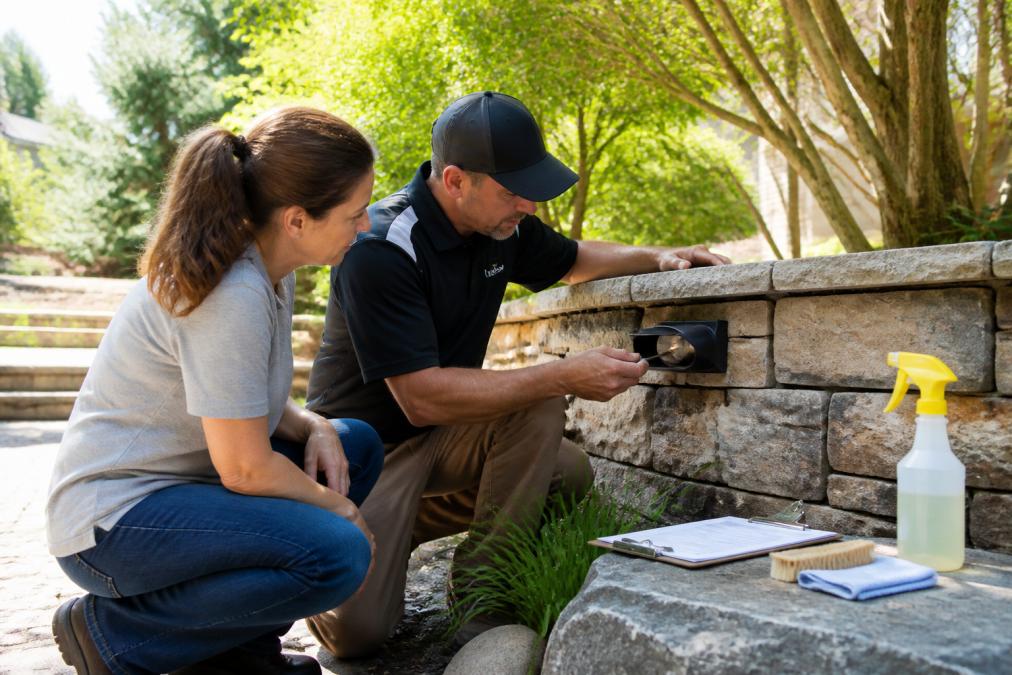
System maintenance is also where smart lighting integration adds real value. Many professional-grade systems now support firmware updates that adjust transformer output schedules, monitor electrical load in real time, and alert homeowners to circuit anomalies before they become failures. This kind of system monitoring transforms reactive maintenance into preventative maintenance.
Understanding the Cost of Professional Landscape Lighting Installation
The cost of professional landscape lighting installation reflects the engineering, materials, and labor required to build a system that actually lasts. It's not comparable to the sticker price on a consumer kit, because the two products are not equivalent.
Professional systems include load-calculated transformer sizing, professional-grade fixtures with verified IP ratings, UV-rated direct-burial cable, sealed connectors, and installation labor from technicians who understand NEC requirements. The system is designed as a complete electrical system, not assembled from parts.
Many homeowners who've dealt with flickering, failed, or frustrating DIY systems find that the cost of professional landscape lighting installation makes more financial sense when viewed over a multi-year horizon. A system that requires annual repairs, partial replacements, or complete reinstallation after three years is not cheaper than a professional system that performs reliably for a decade or more.
Return on investment for permanent outdoor lighting also extends to property value. Professionally installed architectural and landscape lighting consistently improves curb appeal and, according to the National Association of Realtors' home improvement impact data, exterior lighting upgrades rank among the highest-ROI improvements homeowners can make before listing a property.
Pricing for professional outdoor lighting systems varies based on property size, fixture count, design complexity, and the specific divisions of service involved. Paramount Outdoor Lighting Group provides custom quotes based on a property walk-through, ensuring the scope and cost reflect the actual project rather than a generic estimate. Request a walk-through to get an accurate picture of what your specific property requires.
Professional lighting installation is an engineering decision as much as an aesthetic one. The systems that last are the ones built on correct load calculations, professional-grade components, proper weatherproofing, and installation techniques that account for the real conditions a fixture will face over years of outdoor exposure. Paramount Outdoor Lighting Group's team brings decades of experience across four specialized outdoor lighting divisions, delivering low-voltage systems designed for long-term reliability rather than short-term impressiveness. Request a walk-through and see the difference that professional-grade design makes from the first night forward.
Frequently Asked Questions
How many years can I expect permanent outdoor lighting to last?
Professional-grade permanent outdoor lighting systems typically last 10 to 15 years or more when properly installed and maintained. LED fixtures rated for outdoor use carry lifespans of 25,000 to 50,000 hours under normal operating conditions. The actual lifespan depends on component quality, weatherproofing integrity, transformer sizing, and how consistently the system receives preventative maintenance. DIY systems using residential-grade parts often fail within two to three years due to voltage drop, corrosion, and connector failures.
Why does improper wiring lead to premature lighting failure?
Improper wiring causes voltage drop, meaning fixtures at the end of a run receive less voltage than they need. This stresses LED drivers, accelerates heat buildup, and causes flickering or complete failure. Undersized wire gauge, loose connectors, and missing circuit protection compound the problem. Professional lighting installation accounts for total electrical load across each circuit, uses correctly rated wire, and seals every connection against moisture, all steps that prevent the wiring failures common in DIY systems.
What is the difference between residential-grade and professional-grade lighting components?
Residential-grade fixtures sold at home improvement stores are built to price points, not performance standards. They typically use thinner housing, lower IP ratings, and connectors that allow moisture intrusion over time. Professional-grade components use UV-rated materials, corrosion-resistant housings, and connectors designed for permanent outdoor exposure. Transformers in professional systems include overload protection and are sized for the full electrical load of the circuit, which residential units rarely account for.
How does professional weatherproofing protect outdoor lighting systems?
Professional weatherproofing goes beyond simply choosing a waterproof fixture. It includes sealed wire connectors, conduit protection in high-exposure areas, correct fixture burial depth for in-ground units, and UV-rated cable jacketing. Installers also account for thermal management, ensuring fixtures have adequate heat dissipation so internal components do not overheat during summer months. Together, these measures protect wiring integrity and fixture durability against rain, freeze-thaw cycles, UV exposure, and soil moisture.
This article was written using GrandRanker