
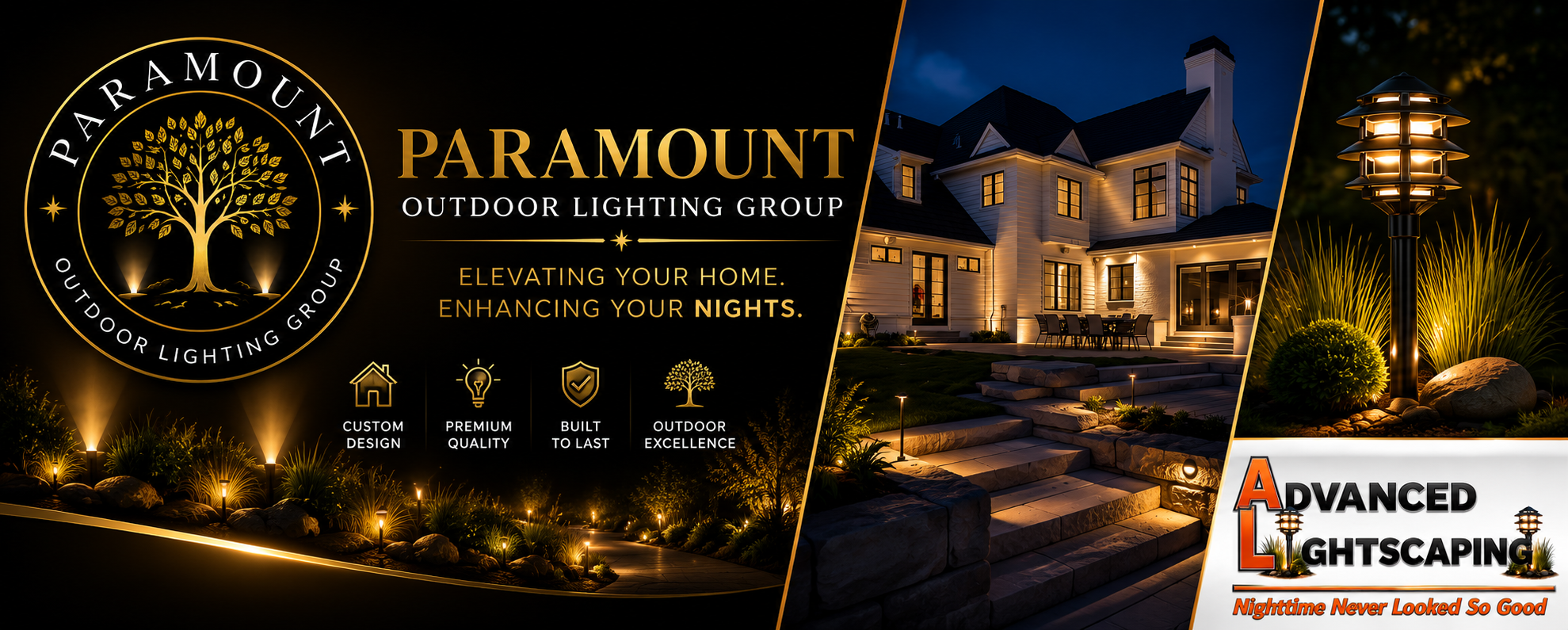
A property has two faces. The first one belongs to the sun. The second one — the better one, in our opinion — only appears after sunset, and only if someone bothered to design it. Paramount Outdoor Lighting Group's landscape lighting division, Advanced Lightscaping, has spent over twenty years designing that second face for the most beautiful homes and commercial properties on Chicago's North Shore.
This page is a complete reference for everything we do in landscape lighting — what we design, how we engineer it, what it costs, why we use the fixtures we use, and how it differs from anything you'll get from a big-box kit or a landscaping crew with a side gig. If you'd rather just talk to a designer, the fastest path is our walk-through request form.
What Is Landscape Lighting?
Landscape lighting is the discipline of using carefully designed, professionally installed exterior fixtures to make a property's architecture, plantings, and grounds beautiful and usable at night. It is not the same thing as security lighting (those are floodlights), and it is not the same thing as a string of solar path markers from a hardware store. Landscape lighting is intentional — every fixture serves a composition.
A well-designed landscape lighting plan answers three questions simultaneously: What do we want people to see? How should people move through the space? And what do we deliberately want to keep in shadow? The art is in the editing.
Core Landscape Lighting Techniques
Most professional landscape lighting plans layer four to six of the following techniques. The mix depends on the architecture, the plant material, and how the property is used at night.
Uplighting
Uplighting is exactly what it sounds like — a fixture in the ground aimed upward at a specimen tree, architectural detail, sculptural shrub, or stone column. It's the workhorse technique of landscape lighting and the most visually dramatic when done right. We use brass well lights for ground-recessed uplighting and brass spot lights with adjustable knuckles for surface-mount applications. Beam spread, lumen output, and color temperature are matched to the subject.
Moonlighting (Downlighting)
Moonlighting — sometimes called downlighting — is the technique of mounting fixtures high in mature trees and aiming them down through the branches. Done correctly, the effect is indistinguishable from a full moon overhead, with dappled patterns of leaf shadow projected on the ground below. Moonlighting is the single most magical effect in landscape lighting. It requires height, mature canopy, and tree-friendly mounting hardware. We use coated cleat hardware that expands with the tree's growth and never girdles bark.
Path Lighting and Walkway Lighting
Path lighting is functional first and beautiful second — it shows guests where the walkway is so nobody trips on a paver. We hate the "runway" effect of evenly spaced identical lights and design path lighting to wash the surface from staggered, varied positions. Our preferred fixtures are mushroom-style brass path lights with internal reflectors that throw a clean elliptical pattern on the ground while keeping glare out of approaching eyes.
Step Lighting
Step lighting is a safety essential the moment a property has more than one elevation. We recess low-output LED fixtures into the risers of every step where falls are a real risk — front entries, garden stairs, deck stairs, and patio drops. Step lighting is also a place where smart controls earn their keep: we wire it to come on at dusk and stay on all night for fall prevention.
Wall Washing and Facade Lighting
Wall washing is the technique of using wide-beam fixtures to bathe a stone, brick, or stucco facade in a soft, even glow. Facade lighting is a closely related discipline that uses tighter beams and grazing angles to emphasize architectural texture — limestone, brick, stone, ornamental woodwork. Both techniques are about reading the building correctly. A federal-revival brick Georgian wants warm, even wash. A modern board-formed concrete wall wants tight grazing from above to catch every form line.
Garden Lighting
Garden lighting is the catch-all for fixtures that highlight ornamental beds, sculptural shrubs, water features, and seasonal blooms. We typically use a mix of low-profile area lights, small uplights, and downlights mounted in nearby trees. The goal is always to light the plant material rather than the fixture — if a guest can see where the light is coming from, we've done it wrong.
Tree Lighting
Tree lighting is its own art. The same Bur Oak can be lit four different ways depending on the design intent — uplit from the base for drama, downlit from the canopy for moonlight, washed from across the lawn for context, or grazed from a tight angle for textured bark. Some properties want all four on the same specimen tree. Some want the tree to disappear and the surrounding garden to take center stage. Tree lighting is a conversation, not a checklist.
Well Lights and Recessed Fixtures
Well lights are uplights designed to sit flush with the ground or with a paver surface. They are the right choice anywhere a visible fixture would interrupt the composition — under specimen trees, in lawn areas, at the foot of stone walls, in driveway aprons. Brass well lights with proper drainage are essentially permanent.
Deck Lighting
Deck lighting overlaps with patio lighting (covered separately) but the landscape lighting side of it includes post cap lights, recessed deck floor lights, and downlights mounted in pergola structures or adjacent trees. The goal on a deck is enough light to use the space without overwhelming the adjacent landscape composition.
Outdoor Lighting Design Process
Every Paramount landscape lighting project follows the same disciplined process. The reason is simple: shortcuts at the design stage create problems that compound at install and haunt the system for years.
1. Walk-Through
A designer visits your property — preferably twice, once during the day to understand the architecture and plantings, and once at dusk to see how the property reads as the light fades. We talk about how you use the space, what you want people to notice, what you want them to miss, and what your maintenance appetite is.
2. Design Plan
You receive a custom landscape lighting design mockup that offers a glimpse into the future of your home, showcasing how it will look after the Paramount Outdoor Lighting installation team works its magic. No surprises—our comprehensive proposals include everything required to make your property the shining star of the neighborhood.
3. On-Site Demo (Optional)
For larger projects we offer a temporary on-site demo using portable fixtures. You see the composition before we install anything permanent. Changes at this stage are free.
4. Installation
Installation is done by Paramount's employees, not subcontractors. We trench discreetly with edging tools that disturb sod minimally, conceal transformers in side yards or mechanical zones, and pull every wire to proper voltage-drop tolerance. A typical residential project is on site for 1–3 days.
5. Night Aim
Every fixture is aimed at night, after install, with the property owner present. This is non-negotiable. A landscape lighting system that wasn't aimed at night is a system that's pointing at the wrong things — guaranteed.
6. Maintenance
Every install is enrolled in our annual landscape lighting maintenance program, which covers re-aiming, bulb replacement, voltage-drop checks, wire repair, transformer testing, and lens cleaning. Most clients schedule maintenance once a year in spring.
Landscape Lighting Installation
Installation is where the difference between a professional landscape lighting company and a weekend installer becomes obvious. The fixture is the visible part. The wire, transformer, hub, voltage-drop math, and weatherproofing are the invisible parts that make the system last 15 years instead of 18 months.
- Direct-burial wire — we use 10-, 12-, and 14-gauge direct-burial low-voltage cable sized to the load.
- Watertight crimp & heat shrink connections — every wire connection is crimped & heat shrunk to defeat moisture and corrosion and withstand the test of time. We do not use scotch-locks, wire nuts, or twisted-and-taped connections.
- Transformer sizing — every transformer is sized to handle the maximum connected load with at least 20% headroom for future expansion, and is installed with a multi-tap output for fine voltage tuning.
- Astronomical timers and smart control — every system gets an astronomical time clock that adjusts dusk and dawn automatically across the year, with optional WiFi-enabled smart control for zoned scenes.
Landscape Lighting Maintenance and Repair
Even the best landscape lighting system needs occasional care. Bulbs drift over time. Lenses get filmed by sprinkler spray. Mulching crews nick wires. Mature trees grow into and out of lighting alignment. Landscape lighting maintenance keeps a system at install-day quality for its full service life.
We also take over and repair landscape lighting installed by other companies. The most common takeover scenarios are: a system installed by a landscaper that's failing because of undersized transformers or poor connections; a system installed five or more years ago that needs LED upgrades and re-aiming; or a system that's been damaged by landscape work and needs partial rewiring. We can usually save 60–80% of the existing investment in a takeover.
LED Landscape Lighting and Low Voltage Lighting
Every Paramount landscape lighting installation is low-voltage LED. The reasons are technical, practical, and aesthetic. Low voltage means 12V at the fixture (transformed down from 120V at the panel), which is dramatically safer to work around, gentler on plant root systems, and easier to adjust without electrical permitting for most modifications. LED sources draw a fraction of the power of incandescent or halogen lamps, last 15–20 years, run cool enough to mount in trees without scorch risk, and are available in calibrated color temperatures from 2200K (extremely warm, candlelight-feel) to 3000K (warm white) to 4000K (neutral).
We default to 2700K for most residential landscape lighting, which reads as a warm, golden, candlelit color that flatters brick, stone, and natural materials. We use 3000K for cooler modern architecture and 4000K only for security or sport applications.
Commercial Landscape Lighting
Our commercial landscape lighting service covers HOA entries and common areas, multi-family communities, restaurants, hotels, office parks, retail centers, churches, and municipal grounds. Commercial scopes use heavier-gauge wire, larger multi-tap transformers, astronomical timeclock controls, lockable fixture covers in public areas, and a formal annual maintenance contract.
We work with HOA boards, property managers, hospitality groups, and municipal planning departments and are familiar with the permitting, dark-sky compliance, and warranty documentation that commercial work requires.
Luxury Landscape Lighting on the North Shore
Luxury landscape lighting on Chicago's North Shore is its own category. The properties are larger, the architecture is more deliberate, and the standard of installation is higher. Our luxury work — concentrated in Winnetka, Glencoe, Kenilworth, Lake Forest, Highland Park, Hinsdale, Oak Brook, Inverness, Long Grove, South Barrington, and Lincolnshire — is brass throughout, hub-and-spoke wired, smart-controlled, and warrantied for as long as the property owner owns the home.
Landscape Lighting Near Me
If you've searched for an "outdoor lighting company near me" or "landscape lighting company near me," you've found one of the most established teams in the Chicago area. Paramount serves over thirty Chicagoland municipalities. A short list:
- Park Ridge, Arlington Heights, Barrington, Inverness
- Winnetka, Glencoe, Wilmette, Highland Park, Lake Forest
- Northbrook, Glenview, Deerfield, Long Grove
- Hinsdale, Oak Brook, Elmhurst
- Chicago proper — Lincoln Park, Lakeview, Bucktown, Logan Square, and Gold Coast
See the complete service area list →
Why Professional Landscape Lighting Looks Better
Anyone can buy a string of solar markers and a kit transformer. Very few people can design a composition that flatters a property at night across every season and lasts two decades. The difference is the engineering — wire gauge, voltage drop math, hub topology, fixture quality, beam selection, color temperature, aiming discipline, and an unwillingness to overlight. Professional landscape lighting is restrained, layered, and almost invisible in its mechanism. You see the property, not the fixtures.
Ready to Light Your Property?
Start with a walk-through. We'll meet you on site, listen to how you use the property, look at the architecture and plantings, and put together a written landscape lighting design plan with a fixed quote. No pressure, no surprise pricing, no commitment.
Frequently Asked Questions
How much does landscape lighting cost in Chicago?+
A starter design with 8–12 brass uplights and a single transformer typically begins around $4,500 installed. A complete estate plan with tree moonlighting, architectural facade washes, path and step lighting, and zoned smart controls ranges from $18,000 to $45,000+. Pricing varies with fixture count, wire runs, voltage drop calculations, and the architectural complexity of the property. Every Paramount quote is fixed — no per-fixture surprises.
What is low voltage landscape lighting?+
Low voltage landscape lighting runs at 12 volts (stepped down from 120V household current through a transformer). It is safer to work around, gentler on plant material, easier to adjust and re-aim, and dramatically more efficient than line-voltage systems. Every Paramount landscape system is low voltage.
How long do LED landscape lights last?+
Modern LED landscape fixtures are rated for 40,000–50,000 hours of use — roughly 15–20 years at a normal dusk-to-dawn schedule. Brass and copper fixture housings often outlast multiple LED generations and can be re-lamped to current technology when needed.
Will landscape lighting damage my trees?+
No. Properly installed landscape lighting uses tree-friendly mounting straps that expand with growth, low-heat LED sources, and beam patterns designed to highlight foliage without scorching it. We never spike fixtures into a tree's root flare or use clamps that girdle bark.
Do you offer landscape lighting maintenance?+
Yes. Every Paramount landscape lighting installation is backed by an annual maintenance plan that covers re-aiming, bulb replacement, transformer testing, voltage-drop checks, wire repair from landscaping damage, lens cleaning, and a full system walk-through with the property owner.
Can you repair landscape lighting that wasn't installed by you?+
Yes. We frequently take over previously installed landscape lighting systems — replacing failed fixtures, upgrading transformers, re-engineering circuits with proper voltage drop, and adding zones for smart control. Many takeover projects also include a design refresh.
How long does landscape lighting installation take?+
Most residential landscape lighting installations are completed in 1–3 days on site. We trench discreetly with edging tools, conceal all transformer locations, and clean as we go. Larger estate projects are scheduled in phases over 4–7 days.
What is the difference between brass and aluminum fixtures?+
Brass fixtures develop a beautiful living patina over time and are essentially permanent — they handle Chicago freeze-thaw cycles indefinitely. Powder-coated aluminum is a lower-cost alternative that performs well but eventually shows wear at edges and joints. For estate-grade installations we recommend brass throughout. For value-conscious projects we use aluminum for path lights and brass for the high-visibility focal fixtures.
Do you serve the North Shore?+
Yes. North Shore landscape lighting is one of our core service areas — Winnetka, Glencoe, Kenilworth, Wilmette, Highland Park, Lake Forest, Lake Bluff, Northbrook, Glenview, and Deerfield. See our service area page for the full list.
Can you light commercial landscapes?+
Yes. We design commercial landscape lighting for HOA entries, multi-family communities, restaurants, hotels, office parks, retail centers, and municipal properties. Commercial systems use heavier-gauge wire, larger transformers, and astronomical timeclock controls.
Related Services
- Patio Lighting — pair landscape lighting with bistro and pergola lighting for complete outdoor rooms.
- Permanent Christmas Lights — add a year-round architectural roofline track.
- Holiday Lighting — seasonal Christmas installs to layer over the landscape system.
- Commercial Outdoor Lighting — for HOA, hospitality, retail, and office properties.