Smart Exterior Lights for Harsh Weather: What Works
Table of Contents
- Do Smart Exterior Lights Actually Perform in Harsh Weather?
- Understanding IP Ratings for Outdoor Lighting
- IP65 vs IP67 Outdoor Lighting: Which Rating Protects Better
- Key Weatherproofing Features That Matter
- Best Low Voltage Outdoor Lighting Fixtures for Year-Round Durability
- Outdoor Smart Lighting Connectivity Issues in Extreme Weather
- Temperature Tolerance and Thermal Management
- Installation and Maintenance for Long-Term Performance
- Frequently Asked Questions
Last Updated: September 25, 2026
Do Smart Exterior Lights Actually Perform in Harsh Weather?
Smart exterior lights harsh weather performance depends entirely on whether they're built with the right weatherproofing features. The key is understanding what "weatherproof" actually means and matching your lights to your climate's specific challenges.
The difference between lights that last for years and those that fail within months comes down to a few critical specifications: temperature swings, moisture exposure, UV damage, and corrosion. Smart exterior lights handle all of this when you choose the right ones.
Understanding IP Ratings for Outdoor Lighting
IP ratings measure water and dust resistance using two digits. For outdoor smart lights, the second digit (water protection) matters most.
IP65 handles water jets and heavy rain. IP67 survives temporary submersion up to one meter deep. Most outdoor smart lights fall into this IP65-IP67 range.
Here's what the numbers actually mean for your lights:
- IP64: Protects against splashing water. Works for covered patios but not exposed areas.
- IP65: Handles water jets and heavy rain. Safe for most outdoor installations.
- IP66: Resists powerful water jets. Best for coastal areas and locations with extreme weather.
- IP67: Survives brief submersion. Ideal for areas prone to flooding or heavy snow melt.
In harsh climates, IP67 lights handle freeze-thaw cycles, heavy snow accumulation, and coastal salt spray more reliably than IP65.
IP65 vs IP67 Outdoor Lighting: Which Rating Protects Better
IP67 protection is stronger but typically costs more due to additional sealing materials.
For most homeowners, IP65 is sufficient if your lights aren't directly exposed to standing water or heavy spray. If you live near the coast, in a flood-prone area, or experience intense freeze-thaw cycles, IP67 is worth the investment.
Over time, IP65 lights may develop internal condensation after 3-5 years, while IP67 lights maintain integrity for 7-10 years or longer.
Consider your specific weather threats:
- Heavy rain and wind: IP65 is adequate.
- Salt spray or coastal mist: Choose IP67.
- Freeze-thaw cycles: IP67 performs better.
- Extended wet seasons: IP67 reduces failure risk.
The best fixtures combine high IP ratings with corrosion-resistant materials: aluminum housings with stainless steel hardware and epoxy-coated circuitry.
Key Weatherproofing Features That Matter
Beyond IP ratings, housing materials, gaskets, sealants, and fastener composition determine durability, especially in coastal or freeze-thaw climates.
Housing Materials and Durability Trade-offs
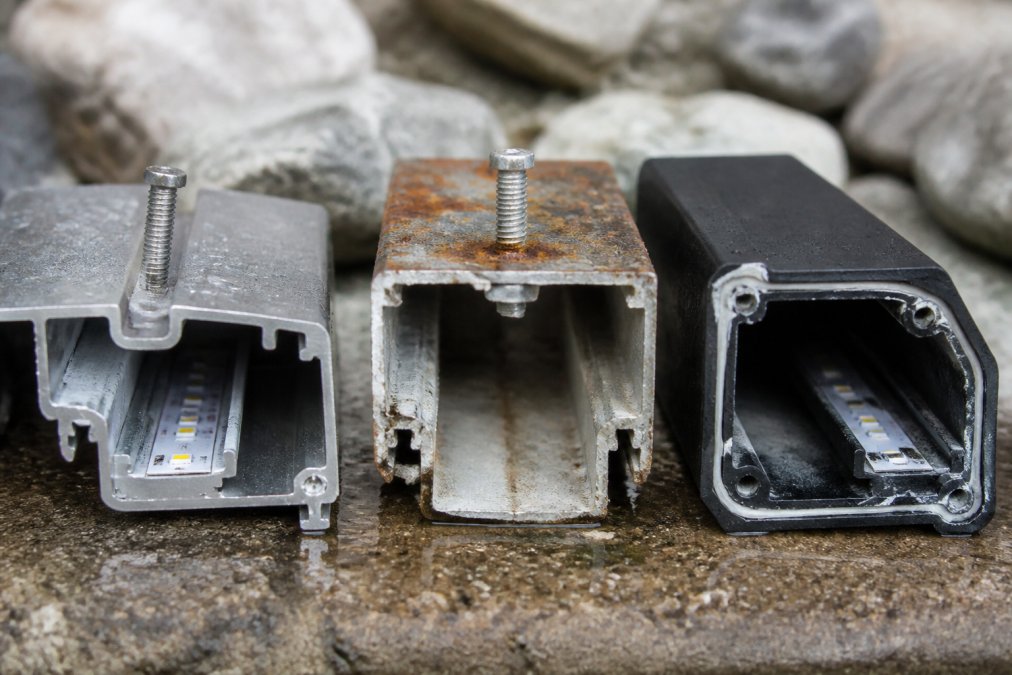
Three materials dominate outdoor smart lighting: aluminum, stainless steel, and UV-stabilized plastic. Each has distinct failure modes under harsh weather.
Aluminum housings offer excellent thermal conductivity and corrosion resistance when anodized. However, galvanic corrosion occurs where stainless steel bolts contact aluminum in moisture. Premium fixtures use stainless steel hardware throughout. Aluminum's expansion with temperature swings stresses gaskets, so quality fixtures use elastomeric gaskets (silicone or EPDM) that flex with the housing.
Stainless steel housings resist corrosion better in coastal environments. 304-grade is standard; 316-grade offers superior salt-spray resistance but costs more. The main drawback is slower heat dissipation than aluminum, which can reduce LED lifespan in high-temperature climates without internal heat sinks.
UV-stabilized plastic housings are lightweight and inexpensive but degrade under prolonged sun exposure. UV stabilizers deplete over 5-7 years, leaving the housing brittle. Plastic is acceptable for covered installations but underperforms in open, sunny locations.
Gaskets, Sealants, and Sealing Strategy
Quality gaskets use silicone or EPDM rubber, which resist UV damage and maintain flexibility through temperature swings. Silicone handles wider ranges; EPDM resists ozone degradation in coastal areas. Double-sealed gasket designs provide redundancy if one seal fails.
Conformal coating on circuit boards prevents condensation from corroding solder joints. Silicone-based coatings offer better flexibility in extreme temperature swings.
Fasteners and Internal Hardware
Stainless steel fasteners resist corrosion far better than galvanized steel. In coastal environments, even one steel fastener can initiate galvanic corrosion. Verify all internal springs, clips, and connectors are stainless or nickel-plated.
Drainage and Thermal Management
Drainage ports allow water to escape rather than accumulate. Fixtures without drainage ports develop condensation after 2-3 years. Ports must be positioned at the lowest point and sized for free water flow.
Thermal management prevents overheating in summer and brittleness in winter. Quality fixtures include aluminum heat-sink plates bonded to the LED module and ventilation channels that allow air circulation without compromising the water seal.
Coastal Corrosion: A Specific Material Challenge
In salt-air environments, fixtures should prioritize 316-grade stainless steel or aluminum with marine-grade epoxy coatings. Regular rinsing with fresh water extends fixture life. Plastic housings fail within 3-4 years in coastal areas.
Best Low Voltage Outdoor Lighting Fixtures for Year-Round Durability
Low-voltage systems dominate the smart outdoor lighting market. When choosing fixtures, focus on these characteristics:
Fixtures rated IP65 or higher with aluminum or stainless steel housings outperform plastic-bodied lights. Thicker walls provide better protection and thermal stability.
Quality LEDs rated for extended temperature ranges (-20°C to 60°C or wider) maintain brightness and color consistency year-round.
Wi-Fi signals weaken in heavy rain and snow. Systems supporting Zigbee or Z-Wave protocols work better in adverse conditions. Hardwired systems eliminate connectivity issues but require professional installation.
Evaluate fixtures based on their use case. A light on a covered patio has different requirements than one exposed to direct wind and rain. Match the IP rating and materials to your specific installation location.
Outdoor Smart Lighting Connectivity Issues in Extreme Weather
Smart features are worthless if your lights lose connection during storms. Many homeowners encounter unexpected problems that aren't obvious until the system is tested through a full seasonal cycle.
Why Weather Degrades Wireless Signals
Water absorbs radio waves at Wi-Fi frequencies (2.4 GHz and 5 GHz). Heavy rain reduces signal strength by 5-15 dB. Wet snow attenuates signals by 20-30 dB. Ice accumulation further degrades signal by blocking line-of-sight paths.
Thunderstorms create electromagnetic noise that drowns out weak Wi-Fi signals. Smart lights 50+ feet from your router may drop offline during thunderstorms.
Distance and Router Placement Challenges
Most Wi-Fi routers have an effective outdoor range of 100-150 feet in ideal conditions; in rain or snow, this shrinks to 50-75 feet. Lights at the edge of this range become unreliable during adverse weather.
Router placement matters significantly. Placing your router near a window facing the outdoor lights improves signal strength. Some homeowners install a dedicated Wi-Fi access point outdoors to eliminate distance-related dropouts.
Alternative Protocols and Their Weather Performance
Z-Wave's 900 MHz frequency is particularly effective in rain and snow because longer wavelengths diffract around water droplets. Zigbee uses mesh networking, if one node loses signal, the network routes around it. Wi-Fi devices connect directly to the router, so signal loss means disconnection.
Hardwired systems eliminate wireless connectivity entirely. The trade-off is installation complexity and cost. Hardwired systems are ideal for new construction or major renovations.
Hybrid systems combine Wi-Fi with Zigbee or Z-Wave for redundancy. If Wi-Fi drops, commands route through the mesh network without the installation cost of fully hardwired systems.
Smart Hub Behavior During Outages
A quality smart hub maintains local automation (dusk-to-dawn, motion detection) even if internet goes down. You lose remote smartphone control, but basic functions continue.
Cheaper smart hubs require internet connectivity for all functions.
Pre-Installation Testing Protocol
Specific testing steps:
-
Measure signal strength at the planned installation location using a Wi-Fi analyzer app on your smartphone. Signal strength below -70 dBm is marginal; below -80 dBm is unreliable in adverse weather.
-
Test during rain and snow if possible. Monitor whether the connection drops or becomes intermittent. If you're testing in summer, simulate weather conditions by running a garden hose near the test light.
-
Test at different times of day because atmospheric conditions affect signal propagation. Morning and evening often have different signal strength than midday.
-
Evaluate mesh network coverage if using Zigbee or Z-Wave. Ensure at least two intermediate nodes (other smart devices) are within range of your outdoor lights so the network can route around signal loss.
-
Document hub behavior during internet outages. Unplug your modem for 30 minutes and verify that local automation (dusk-to-dawn, motion detection) continues working. This confirms the hub has local processing capability.
Temperature Tolerance and Thermal Management
Extreme temperatures stress every component in outdoor lighting systems. Cold causes materials to contract, hot weather causes expansion. Repeated cycles crack solder joints, degrade gaskets, and reduce LED lifespan.
Installation and Maintenance for Long-Term Performance
Professional installation matters more than most homeowners realize. Improper mounting exposes gaskets to unnecessary stress. Incorrect wiring creates voltage drops that shorten LED life and cause flickering. Poor grounding increases failure risk during electrical storms.
Key installation practices that extend system life:
- Secure mounting: Prevents vibration that degrades connections.
- Proper wire sizing: Prevents voltage drop and overheating.
- Correct grounding: Protects against lightning and electrical surges.
- Adequate drainage: Routes water away from light housings.
- Protected wiring: Uses conduit in exposed areas to prevent UV damage and physical damage.
Frequently Asked Questions
What IP rating do smart exterior lights need for harsh weather?
Smart exterior lights should have at least an IP65 rating for general outdoor use, which protects against water jets and dust. For coastal environments or areas with heavy moisture, IP67 or higher provides better protection against temporary submersion and corrosion. The first digit (6 or 7) indicates dust protection; the second digit (5 or 7) indicates water resistance. Check the product specifications before purchase to ensure the rating matches your climate.
Do smart outdoor lights require a hub to function in cold weather?
Most smart exterior lights use Wi-Fi connectivity or a dedicated smart hub to enable remote control and automation. Cold weather can affect signal strength and battery performance in wireless sensors, but hardwired smart lighting systems remain stable in freezing temperatures. If your area experiences extreme cold, hardwired low-voltage systems with smart controls offer more reliable year-round connectivity than battery-powered or Wi-Fi-only options.
Can smart light bulbs be used outdoors without a protective fixture?
Standard smart bulbs are not rated for outdoor use without protection. They lack the weatherproofing, corrosion-resistant materials, and sealed circuitry required to survive moisture, temperature swings, and UV exposure. Always use smart bulbs designed specifically for outdoor applications or install them inside weatherproof fixtures rated IP65 or higher. This ensures durability and prevents electrical hazards.
What causes smart outdoor lights to fail in harsh weather?
Common failure causes include inadequate IP ratings, moisture penetration through unsealed connections, thermal stress from freeze-thaw cycles, corrosion of unprotected metal components, and signal loss from smart hubs located too far away. Poor installation, exposed wiring, missing gaskets, or insufficient drainage, accelerates failure. Using low-voltage hardwired systems with proper sealants and materials rated for your climate significantly extends lifespan and reliability.