How to Choose Outdoor Holiday Lights: 2026 Buying Guide
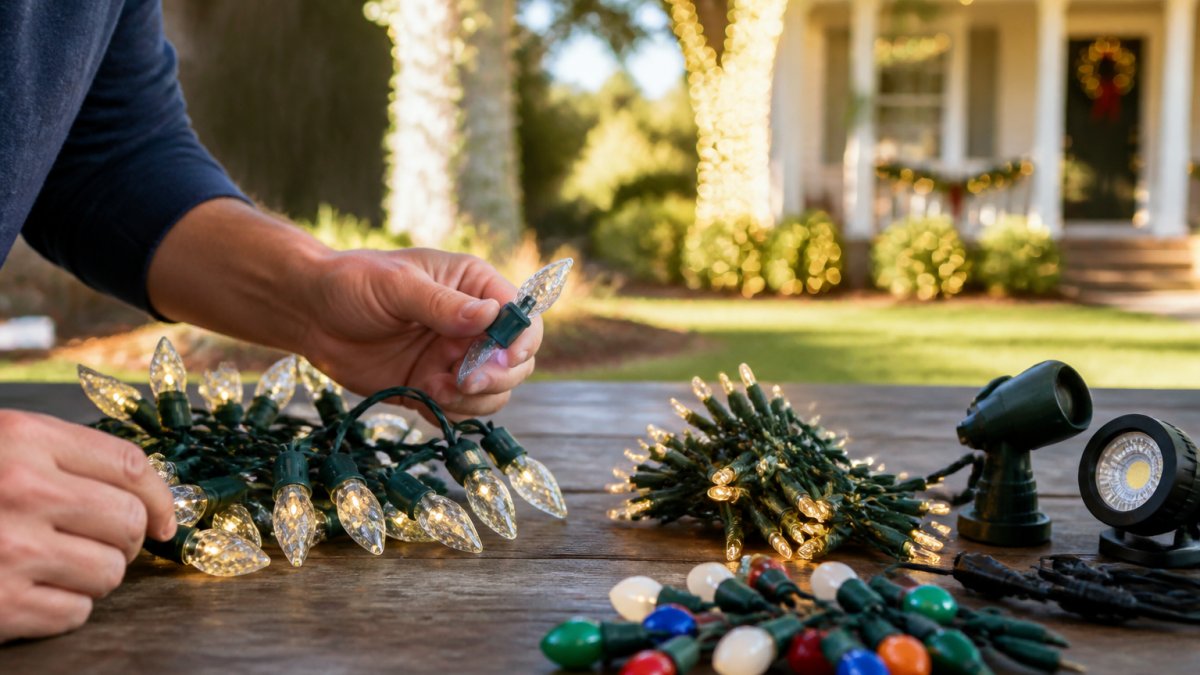
Table of Contents
- Start With a Plan: Measure Your Space and Set a Budget
- LED vs. Incandescent Outdoor Holiday Lights
- Bulb Styles, Sizes, and Formats: C7, C9, String Lights, and Rope Lights
- How to Calculate Holiday Light Footage
- Color, Brightness, and Matching Strands Across Your Display
- Outdoor Holiday Lighting Safety Standards and Electrical Planning
- Permanent Architectural Lighting for Residential Homes
- Frequently Asked Questions
Last Updated: October 20, 2026
Start With a Plan: Measure Your Space and Set a Budget
Choosing outdoor holiday lights starts with two numbers: the linear footage of every surface you want to light and your total budget. Everything else, bulb size, color, control method, follows from those two figures.
Walk the property in daylight with a tape measure and a notepad. Record the roofline, gutter runs, window frames, porch columns, tree trunks, and shrub beds separately.
Then set a realistic budget. Pricing depends on quantity, strand length, and whether you want professional installation, so get a quote rather than guessing from a big-box shelf tag.
LED vs. Incandescent Outdoor Holiday Lights
LED outdoor holiday lights use a fraction of the electricity of incandescent bulbs and last far longer, which is why most new displays are LED.
Here's the practical trade-off:
| Factor | LED | Incandescent |
|---|---|---|
| Power draw | Low | High |
| Bulb life | Long | Short |
| Heat output | Minimal | Noticeable |
| Color options | Wide, including tunable | Limited |
| Upfront cost | Higher | Lower |
| Cold-weather performance | Reliable | Can dim in deep cold |
For a roofline that stays up for six weeks, LED wins on durability and energy. For a small indoor tree or a nostalgic look, incandescent still has a place. If you're planning a permanent system, LED is the only sensible choice.
Bulb Styles, Sizes, and Formats: C7, C9, String Lights, and Rope Lights
C7 and C9 bulbs are the two classic outdoor sizes, differing in diameter and visual weight. C7 measures roughly 7/8 inch across and suits window frames and smaller features; C9 measures about 1-1/8 inch and reads better from the street on rooflines and large trees. Both come as socket stringers you populate with replaceable bulbs, which makes repairs simple.
C7 vs. C9: Which Bulb Size Fits Your Display?
Pick C7 for detail work and C9 for distance. A C9 on a gutter 20 feet up looks proportionate; the same bulb on a porch rail looks oversized. Many displays mix both, using C9 along the roof and C7 on windows and railings for a layered effect.
String Lights, Rope Lights, and Large-Bulb Options
Mini string lights remain the most flexible format: cheap, easy to drape through shrubs, and available in long connectable runs. Rope lights give a continuous line of light with no visible bulbs, useful for outlining walkways or columns. Large-bulb strands, including the C9 socket stringers above, anchor the roofline. Match formats to the job rather than defaulting to one type everywhere.
How to Calculate Holiday Light Footage
To calculate holiday light footage, measure each run, add 10 to 15 percent for sag, corners, and connection slack, then divide by the usable length of your chosen strand. Most mini-light strands list their lighted length, not the total including the lead cord, so read the label carefully.
A simple formula:
- Measure the run in feet
- Multiply by 1.15 for slack and corners
- Divide by the lighted length per strand
- Round up to the next whole strand
For a 40-foot gutter run, that's 46 feet of coverage; if your strand lights 15 feet, you need four strands. Buy one spare per color. Bulb spacing matters too: tighter spacing looks denser and brighter, wider spacing stretches coverage but thins the effect.
Color, Brightness, and Matching Strands Across Your Display
Color consistency separates a polished display from a patchwork one, and the right palette depends on the holiday, not just the house. Warm white (roughly 2700K to 3000K) flatters brick and wood and reads as traditional; cool white (4000K and up) suits modern facades. Multicolor strands work for playful family displays but are harder to match across brands.
A Palette for Every Holiday, Not Just December
The same roofline can carry several looks across the year. A practical approach is to pick a neutral base layer and swap the accent layer by season:
- Winter holidays: warm white or cool white as the base, with red and green accents on shrubs and porch rails. Warm white on the roofline, colored accents at eye level, is the most common professional pattern.
- Valentine's Day: red and warm white, or pink and white, kept to porch rails, windows, and a single tree rather than the whole roofline.
- Spring and summer holidays: red, white, and blue for patriotic occasions; pastel or warm white for spring gatherings. Cool white reads cleaner against light siding in bright months.
- Fall: amber and warm white, which flatter pumpkins, mums, and bare branches better than cool white.
If you want one hardware purchase to cover all of it, a tunable or RGB system lets you change palette by app rather than by restringing. That is the practical argument for smart controls covered below.
Brightness, Not Just Color
Brightness is measured in lumens, and the number on the box matters more than the marketing word "bright." A roofline much brighter than the shrubs below it looks unbalanced; aim for consistent intensity across the main surfaces, then add accent lighting where you want the eye to land. Tighter bulb spacing reads denser and brighter at the same wattage. Dimming, through a smart plug or dimmable controller, lets you run the display softer on ordinary nights and brighter for a party.
Matching Strands Across Brands and Dye Lots
Buy all strands in one order from one manufacturer when you can. Dye lots vary, and two "warm white" strands from different production runs can look noticeably different side by side. If you must mix brands, test them together on the ground at dusk before hanging, and keep the mismatched pair on surfaces that do not touch. Note the color temperature and model number so you can reorder the same batch next year.
Timers, Smart Plugs, and Scheduling
Automation is the easiest upgrade most displays are missing. A plug-in timer turns the display on at dusk and off at a set hour, saving energy and removing the nightly decision. A smart plug adds app control and schedules from your phone; a full smart controller adds color changes, scenes, and music sync. For most homeowners, a timer plus one smart plug on the main roofline run covers the convenience and energy case without a full controller.
Outdoor Holiday Lighting Safety Standards and Electrical Planning
Outdoor holiday lighting safety comes down to three things: products rated for exterior use, electrical load within the circuit's capacity, and water kept away from every connection. Most failures trace back to one of those three, not to the lights themselves.
Start With the UL or ETL Mark
Look for the UL or ETL mark on every strand, extension cord, and power strip, and confirm the rating says "outdoor" rather than "indoor/outdoor" only. The mark means the product was tested to a published safety standard; an unmarked strand from a bin at the register has no such testing behind it. The U.S. Consumer Product Safety Commission publishes holiday-light and extension-cord guidance worth reading before a large install, and the Electrical Safety Foundation maintains plain-language checklists for outdoor cords and connections.
Do the Load Math Before You Plug In
Every strand has a wattage rating printed on the tag or plug. Add up the wattage of everything you plan to connect to a single circuit, then compare that total to the circuit's capacity.
LED strands make this easy: a typical 100-bulb mini-LED strand draws only a few watts, so a whole roofline may use less power than a single incandescent strand. Incandescent strands draw roughly 40 to 50 watts per 100 mini bulbs, which is why older displays tripped breakers.
Respect Strand Limits and Cord Gauge
Never connect more strands end-to-end than the manufacturer's rating allows; that number is on the tag and is usually lower for incandescent than for LED. Overloading a run is one of the most common causes of tripped breakers and melted plugs, and it voids most warranties. For extension cords, match the wire gauge to the run length and load: a 16-gauge cord is fine for a short, light load, but a long run to a tree or shed needs 14- or 12-gauge wire to avoid voltage drop and heat.
Ground-Fault Protection and Fastening
Use ground-fault circuit interrupter protection for anything outdoors, whether a GFCI outlet, an in-line GFCI cord, or a portable GFCI adapter. Test the GFCI before the season starts and after any storm. Fasten strands with clips rated for your siding, shingles, or gutters rather than nails or staples, which damage both the surface and the wire insulation. On metal gutters and downspouts, keep energized wire from contacting the metal, and route cords so they are not pinched by doors, windows, or garage doors.
Permanent Architectural Lighting for Residential Homes
Permanent architectural lighting for residential homes solves the problem seasonal strands create: setup, takedown, storage, and the annual scramble.
These systems offer millions of color and pattern options, so the same hardware handles holidays, game days, and everyday accent lighting.
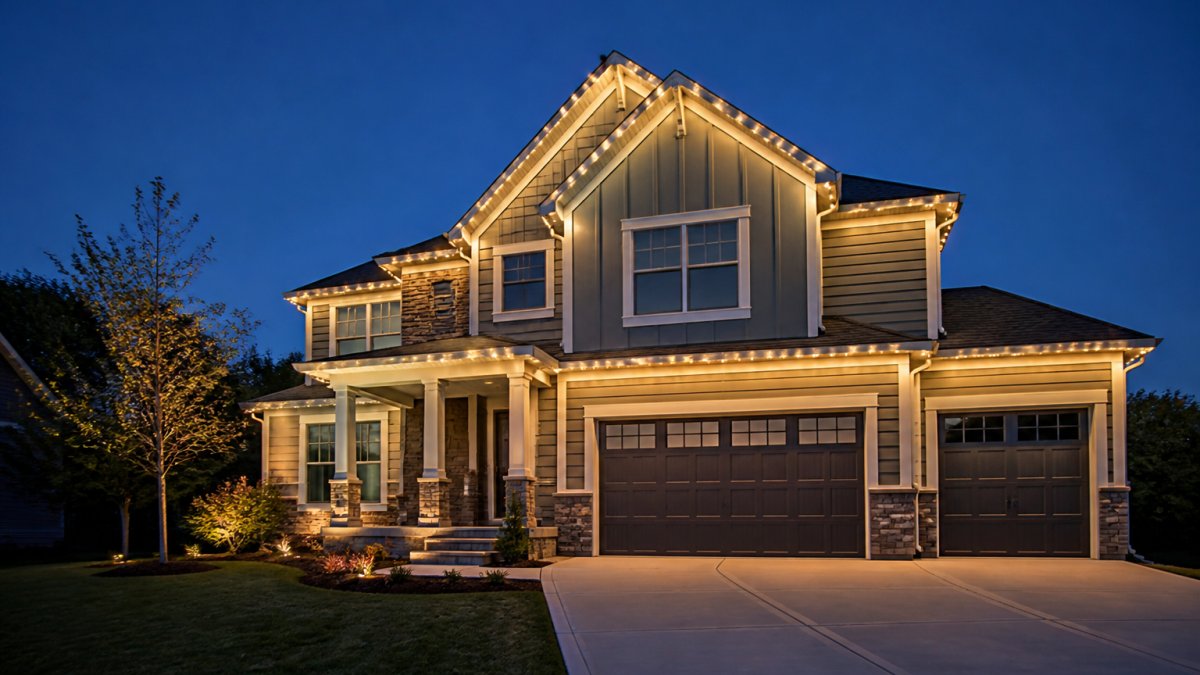
Choosing outdoor holiday lights gets complicated fast once you factor in bulb sizes, footage math, electrical load, and ladder work on a two-story facade.
Frequently Asked Questions
How many feet of outdoor holiday lights do I need for my roofline?
Measure the linear run of your roofline, then add 10 to 15 percent for peaks, valleys, and connection slack. For shrubs, estimate roughly 100 lights per foot of shrub height for a dense look. For trees, wrap trunks and main branches rather than the whole canopy. Knowing how to calculate holiday light footage before you buy prevents mid-install shortages and mismatched strands, since dye lots and color temperatures can vary between orders.
Are LED or incandescent outdoor holiday lights better for long-term displays?
LED outdoor holiday lights use far less wattage, run cooler, and typically last years longer than incandescent bulbs, which makes them the better choice for displays you plan to keep up season after season. Incandescent bulbs give a warmer glow but draw more power and burn out faster. For rooflines, trees, and shrub lighting that stays up for weeks, LED strands reduce power consumption and the frequency of replacement bulb swaps.
Is permanent architectural lighting worth it compared to temporary holiday lights?
Permanent architectural lighting for residential homes installs once and stays up year-round, so you skip the annual ladder work, storage, and removal cycle. It also gives you control over color and brightness for holidays, parties, and everyday curb appeal. Temporary strands cost less upfront but add up over years of replacements. For homeowners who decorate every season or want year-round exterior lighting, permanent systems often deliver more value.
What should I check before plugging in outdoor holiday lights?
Confirm every strand is outdoor-rated and UL listed for wet locations, and check cords for fraying or cracked sockets before use. Plug into GFCI-protected outlets, keep connections off the ground, and never overload a circuit. Add up the wattage on each run and stay within the circuit's capacity. Outdoor holiday lighting safety standards exist for a reason: a few minutes of checking cords, clips, and load limits prevents most common failures and hazards.