Exterior Lighting for Business Brand Visibility
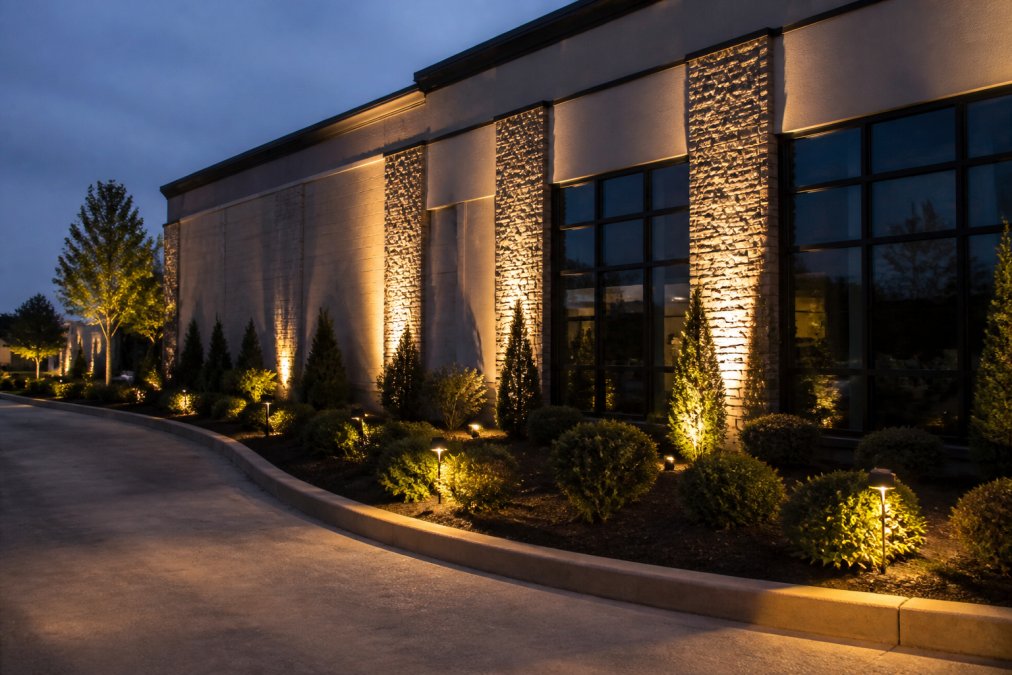
Table of Contents
- Why Exterior Lighting Drives Business Brand Visibility After Dark
- Commercial Outdoor Lighting Design Best Practices for Maximum Impact
- How to Light a Brick House Exterior at Night Without Washing Out the Facade
- Permanent Roofline Lighting for Businesses: Year-Round Brand Presence
- Safety, Security, and Smart Lighting Integration
- Energy Efficiency, ROI, and Maintenance Costs
- Light Pollution, Dark Sky Compliance, and Community Impact
- Frequently Asked Questions
Last Updated: September 16, 2026
Why Exterior Lighting Drives Business Brand Visibility After Dark
Roughly half of all customer visits to restaurants, hotels, and retail centers happen after sunset, which means exterior lighting for business brand visibility is not a decorative extra. It is the first impression your building makes when most people are actually out spending money. This guide from Paramount Outdoor Lighting Group breaks down the design principles, technology choices, and compliance rules that separate a property that glows with intent from one that just looks lit.
A restaurant with a dark facade after 7 p.m. reads as closed, even with the doors open. A hotel entrance with harsh floodlights reads as cheap. Lighting is branding, and it works whether you manage it or not.
Below, we cover how light layering, color temperature, roofline systems, smart controls, and dark sky rules all feed into one outcome: a property people notice, trust, and walk into.
Commercial Outdoor Lighting Design Best Practices for Maximum Impact
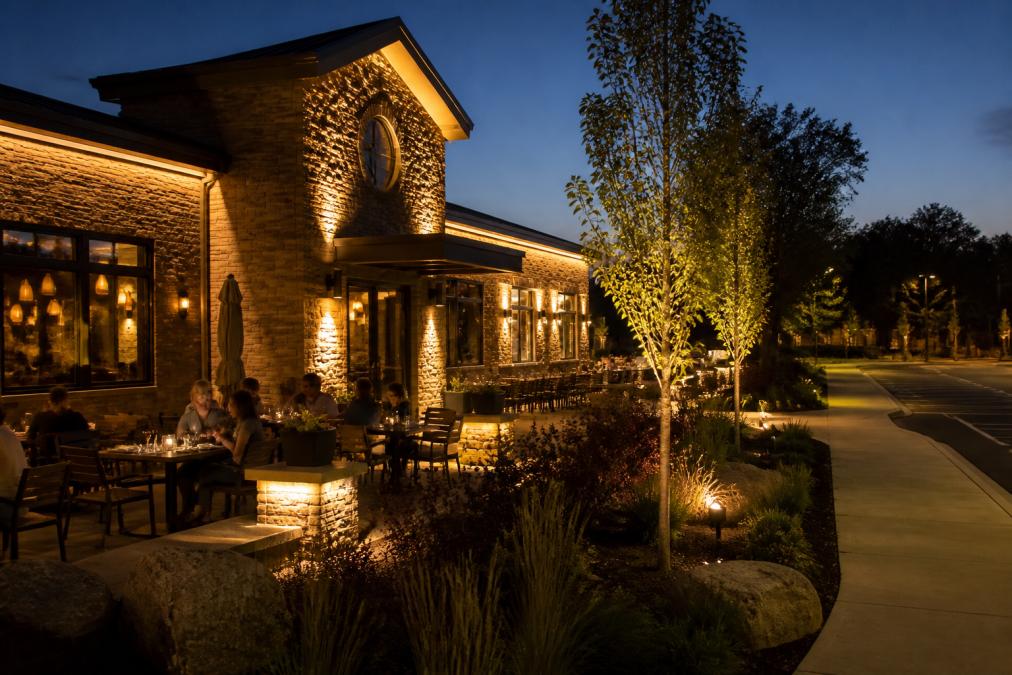
Commercial outdoor lighting design best practices start with one principle: layer your light instead of flooding the property with a single source. A layered layout gives depth, guides the eye, and keeps the building readable from the street.
Layering Light: Ambient, Accent, and Task
Ambient light establishes the base level across parking areas and walkways. Accent light picks out architectural features: columns, signage, textured facades. Task light handles specific zones where people need to see, like entrances, stairs, and patio tables.
Most properties that look "off" at night are missing the middle layer. Ambient and task lighting exist, but nothing draws the eye upward to the building itself.
Color Temperature and the Psychology of Light
Color temperature, measured in Kelvin, changes how people feel about a space before they read a single sign. Warm light around 2700K to 3000K feels inviting and suits restaurants, hotels, and retail storefronts. Cooler light around 4000K to 5000K reads as clinical or secure, which fits parking structures and service areas.
Mixing temperatures across one facade is a common mistake. It makes a building look patched together, and it undermines the brand identity the owner spent money building.
How to Light a Brick House Exterior at Night Without Washing Out the Facade
Brick is one of the most common commercial facades in older downtown corridors, and it is also the hardest to light well. The same principle that applies to a brick house applies to a brick storefront: graze the surface at a shallow angle instead of pointing a floodlight straight at it. Flat frontal lighting erases brick's texture into an orange blur and makes a well-maintained building look tired.
The mechanism is simple. Brick has relief, mortar joints, tuckpointing, corbeling, and in older buildings, uneven firing that leaves color variation across individual units. A grazing beam, aimed nearly parallel to the wall, throws each of those features into micro-shadow. That shadow is what the eye reads as texture and, by extension, as quality. A floodlight aimed perpendicular to the wall fills those shadows in and flattens the surface.
Here is the process that works on commercial brick:
- Mount fixtures close to the wall, typically 12 to 24 inches out, and aim up or down the face of the brick rather than across it
- Keep the beam angle narrow (10° to 25° works for most two- and three-story facades) so light grazes rather than floods
- Set output low enough that mortar lines stay visible in shadow; if you can't see the joints, you're over-lighting
- Use warm color temperature (2700K to 3000K) to complement red and brown brick tones; cooler light turns red brick muddy and gray
- Aim away from windows and glass doors to avoid interior glare and complaints from tenants
- Space fixtures based on beam spread, not on stud spacing, a common mistake is to line fixtures up with the building's structural bays instead of with the light pattern
This same approach applies to commercial brick facades, which is why property managers often ask for it by name. It also pairs naturally with the roofline systems covered below: the roofline defines the building's silhouette, and the facade grazing defines its surface. Designed together, they read as one system. Designed separately, they compete.
Permanent Roofline Lighting for Businesses: Year-Round Brand Presence
Permanent roofline lighting for businesses solves a problem seasonal lighting cannot: consistency. A roofline system installed once stays up year-round, so your building carries a defined outline every night instead of going dark for ten months.
These low-voltage LED systems also handle holiday and event needs without a ladder. Color and pattern changes run through an app, so a hotel can shift from warm white on a normal Tuesday to brand colors for a grand opening, then to holiday displays in December.
Paramount Outdoor Lighting Group installs permanent roofline systems as one of its four specialist divisions, alongside landscape, holiday, and architectural lighting. Having all four under one roof matters because a roofline system and a landscape layout should be designed together, not bolted on separately.
Safety, Security, and Smart Lighting Integration
Lighting that prevents incidents is different from lighting that looks good, and the two goals sometimes pull in opposite directions. Security lighting needs coverage and consistency; design lighting needs contrast and restraint. Most commercial properties end up with one or the other, which is why so many parking lots look like prison yards and so many storefronts look beautiful but leave the back door in the dark.
Motion sensors bridge that gap. A parking area can sit at a low ambient level, say 0.5 foot-candles, roughly the level of a well-lit sidewalk, and jump to full output when someone walks through.
- Astronomical time clocks shift on/off times with sunset and sunrise through the year, so you're not re-programming timers every season
- Occupancy schedules dim common areas after tenant hours and bring them back up before the morning rush
- Scene control lets a restaurant shift from a bright, welcoming entry at 6 p.m. to a softer, more intimate facade at 10 p.m. without touching a single fixture
- Fault reporting flags a fixture that stops drawing current, so maintenance is dispatched before a customer notices a dark corner
The brand-visibility angle here is often overlooked. Security lighting that is too bright or too cool reads as institutional, and institutional is the opposite of what a hospitality or retail brand wants. The fix is not to choose between safety and brand, it is to use the same fixtures at different output levels. A warm 3000K fixture at 30% output reads as welcoming; the same fixture at 100% output reads as secure. Smart controls let a single system do both jobs across the course of an evening.
Energy Efficiency, ROI, and Maintenance Costs
LED technology changed the math on commercial exterior lighting. LED fixtures draw a fraction of the wattage of legacy halogen or metal halide lamps for the same lumen output, and they hold their brightness far longer before needing replacement.
Light Pollution, Dark Sky Compliance, and Community Impact
Light pollution is the part of exterior lighting most business owners never think about until a neighbor or a city inspector does. Many municipalities enforce lighting ordinances that cap uplight, set maximum foot-candle levels at property lines, and require full cut-off fixtures that direct light downward.
Frequently Asked Questions
How does exterior lighting improve business brand visibility?
Exterior lighting extends your brand presence past sunset by illuminating signage, architecture, and entryways so customers can find and recognize your business after dark. A consistent lighting scheme reinforces brand identity through color temperature, fixture style, and placement. Well-lit storefronts and restaurants also signal that a business is open and welcoming, which encourages foot traffic and after-dark visits.
What color temperature should I choose for business signage lighting?
Most businesses use 3000K to 4000K for signage and facades. Warm white (2700K-3000K) suits restaurants and hospitality because it feels inviting, while cooler white (4000K-5000K) works for offices, retail, and medical buildings where a crisp, professional look matters. Matching the Kelvin rating across fixtures keeps your brand look consistent and avoids a patchy, mismatched appearance.
What are the best exterior lights for a commercial building?
The right fixtures depend on the goal. Floodlights and wall packs handle security and parking areas. Architectural uplights and wall washers highlight facades and columns. Roofline and soffit lighting define the building's outline. Landscape lighting guides customers along paths. LED technology should be the baseline for all of them because it lowers wattage, cuts maintenance costs, and holds color consistency far longer than older options.
How do I avoid light pollution while lighting my business?
Choose fixtures with shields or cutoffs that direct light downward onto your property instead of into the sky or neighboring lots. Use the lowest lumen output that still meets safety and visibility needs, and set timers or motion sensors so lights run only when needed. Many municipalities enforce dark sky compliance or lighting ordinances, so check local rules before finalizing a layout.