
7 Best Landscape Lighting Ideas for Front Yards
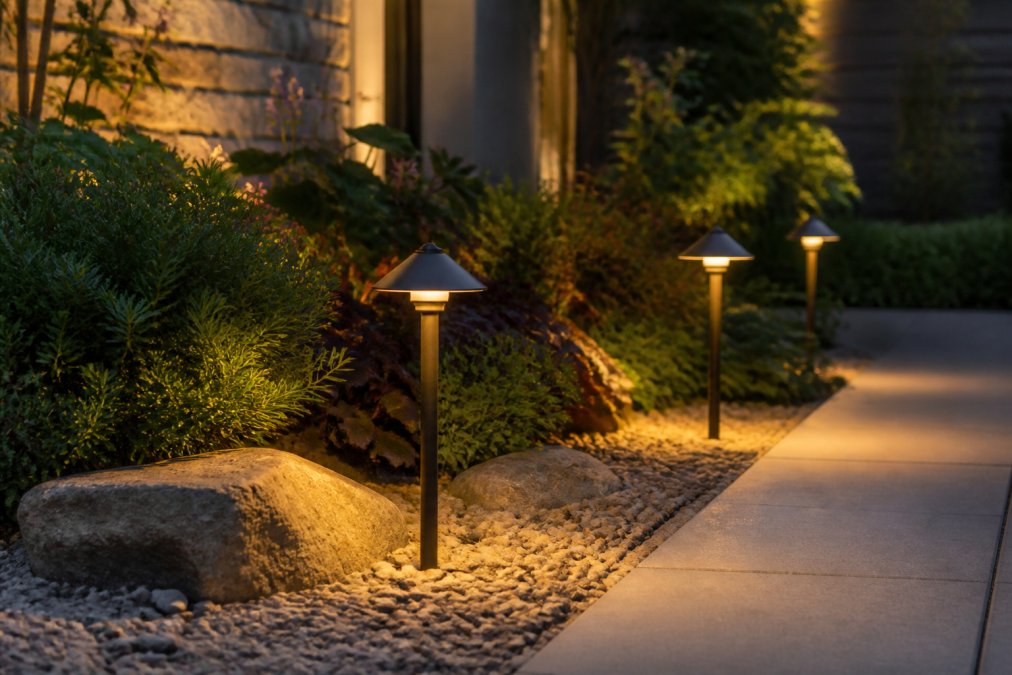
Table of Contents
- Path Lighting: Creating Safe and Inviting Walkways
- Uplighting and Spotlighting for Architectural Features
- Front Door and Entryway Illumination
- How to Choose the Right Color Temperature for Outdoor Lights
- Best Outdoor Lighting for Home Security
- Landscape Lighting Ideas That Balance Aesthetics and Function
- Maintenance and Seasonal Care for Outdoor Lighting Systems
- Frequently Asked Questions
Last Updated: September 24, 2026
Path Lighting: Creating Safe and Inviting Walkways
Path lighting transforms your front yard from a safety hazard into a welcoming entrance after dark. These low-voltage fixtures guide visitors safely while adding curb appeal that lasts all night.
The best path lights sit 12-18 inches tall and space roughly 3-4 feet apart along walkways. This spacing prevents dark gaps while avoiding excessive brightness that looks harsh. Most homeowners find this rhythm feels natural and functional.
Path lights keep people safe while framing your entrance beautifully, creating visual rhythm that draws the eye toward your front door.
Consider these placement strategies:
- Line both sides of walkways for symmetry and safety
- Space lights 3-4 feet apart for even illumination
- Position them slightly offset from the path edge
- Use warm white lights (2700K) for an inviting feel
- Choose weather-resistant fixtures rated IP65 or higher
Professional landscape lighting ideas rely on consistency: even spacing and matched fixtures make the design feel intentional rather than random.
The ones that impress most rely on this simple principle: path lighting should fade into the background by day and shine clearly by night.
Uplighting and Spotlighting for Architectural Features
Uplighting shines light upward from ground level to highlight textures, columns, and stone details. Spotlights focus narrow beams on specific focal points like trees or statues. Both add drama, but subtlety is key, overly bright fixtures look theatrical rather than elegant.
Placement matters enormously:
- Position uplights 2-3 feet away from walls or features
- Angle spotlights 30-45 degrees for natural shadowing
- Use 20-40 watt equivalent LED fixtures for most applications
- Choose warm white (2700K-3000K) for residential elegance
- Test angles at night before finalizing installation
Architectural uplighting works best on homes with interesting details like stone facades, brick, or arched entryways. Flat vinyl siding offers less to highlight, so prioritize other landscape lighting ideas instead.
Placing uplights too close to the wall creates harsh shadows and washes out detail. Step back 2-3 feet, angle upward slightly, and let light travel naturally across the surface.
Front Door and Entryway Illumination
Your front door deserves dedicated lighting. Effective entryway lighting combines overhead fixtures, accent lighting, and path lighting to create a welcoming, functional space.
Overhead fixtures should provide 50-100 lumens, enough to see a key in the lock and read house numbers.
Flanking sconces add elegance and balance, creating symmetry while softening overhead brightness. They work especially well on traditional and colonial-style homes.
Consider these options for entryway lighting:
- Overhead fixture with motion sensor for security
- Matching sconces on both sides of the door
- Pathway lights leading to the entrance
- Accent lighting on door frame or surrounding landscaping
- Dimmable controls for flexibility
Warm white color temperature (2700K) feels most welcoming at entryways. Cool white (4000K+) reads as institutional and cold. This single choice dramatically affects how guests perceive your home.
Sconces typically sit 3-4 feet from the overhead fixture on each side for balanced spacing that feels intentional.
How to Choose the Right Color Temperature for Outdoor Lights
Color temperature measured in Kelvin (K) defines whether outdoor lights feel warm, neutral, or cool. This choice shapes mood, visibility, and how your home's materials appear at night. Understanding the science behind the numbers helps you make decisions that last.
Warm white light (2700K-3000K) mimics incandescent bulbs and feels inviting, it's psychologically associated with comfort and safety. The trade-off: it provides less visual clarity than cool light and makes fine details harder to spot.
Neutral white (3500K-4100K) provides better color rendering than warm white while avoiding the harsh feel of cool light. It's ideal for accent lighting on architectural features where you want to see detail without sacrificing residential warmth.
Cool white (5000K+) creates sharper shadows and higher contrast, making it excellent for security. However, it emphasizes imperfections and feels clinical in residential settings. Most homeowners use it only for motion-sensor security lights.
Color temperature affects perceived brightness: a 2700K fixture at 100 lumens appears dimmer than a 5000K fixture at the same output, so you may need higher wattage in warm white to achieve equal visibility.
Choosing the right temperature depends on three factors:
Your home's material palette. Warm white flatters warm-toned materials like brick and cedar. Neutral white works universally. Cool white reveals true color but feels institutional in residential settings.
Your lighting goal. Use warm white (2700K) for ambient and pathway lighting. Neutral white (3500K-4100K) for architectural accent lighting. Cool white (4000K-5000K) for security and motion-sensor fixtures.
Local conventions. Subdivisions with consistent warm-white lighting look cohesive. Check what your neighbors use before committing to a color temperature.
Consistency matters more than perfection. Mixing multiple color temperatures in one yard creates visual chaos and makes the space feel disjointed. Professional installations typically use one primary temperature (almost always 2700K) for all ambient, pathway, and accent lighting, then reserve a cooler tone for security fixtures only if needed.
Test color temperatures at dusk using your smartphone flashlight (most phones have this feature in the camera app) to see how warm and cool light interact with your specific materials and style.
Best Outdoor Lighting for Home Security
Security and aesthetic lighting often feel like competing goals. The solution is layering them strategically so each reinforces the other.
The security-aesthetics balance works through three principles: layering by purpose, strategic placement, and intentional darkness.
Layering by purpose means assigning different fixtures different jobs. Pathway lights (50-100 lumens, warm white, continuous) create safe wayfinding and frame your property's perimeter, they're beautiful and functional. Motion-activated fixtures (100-150 lumens, cool white, sensor-triggered) guard vulnerable areas like side yards, back corners, and garage approaches, they're bright and deterrent-focused. Accent lighting on architectural features and trees (20-40 lumens, warm white, continuous or timer-controlled) adds visual interest and draws attention to intentional design, they're purely aesthetic.
Consider this placement strategy for a typical front yard:
- Front walkway: Continuous warm-white path lights (2700K, 50-75 lumens each, spaced 3-4 feet apart). These guide visitors safely and frame your property's public face.
- Front door: Overhead fixture (100 lumens, warm white, continuous or dusk-to-dawn timer) plus optional motion sensor for added security. Flanking sconces add elegance and balance.
- Architectural accent lighting: Uplights on stone features, trees, or interesting architectural details (20-40 lumens, warm white or neutral white, continuous or timer-controlled). These create visual interest and draw attention to intentional design.
- Side and back yards: Motion-activated fixtures (100-150 lumens, cool white, sensor-triggered) positioned 6-8 feet high above entry points and vulnerable areas. These remain dark until movement triggers them.
- Garage apron (if visible from street): Optional motion fixture (100+ lumens, cool white) for security and task lighting.
Landscape Lighting Ideas That Balance Aesthetics and Function
The best landscape lighting ideas serve both purposes simultaneously. Beautiful lighting that doesn't work is just decoration. Functional lighting that looks harsh is security theater.
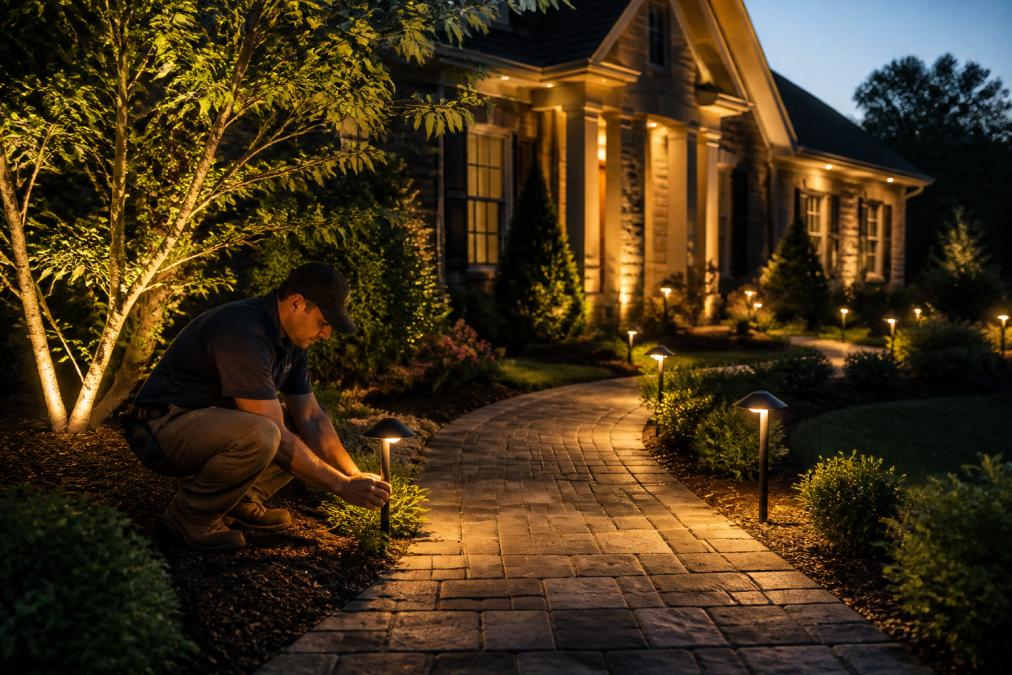
Homeowners who want their landscape lighting to look intentional and professional without the institutional feel of over-bright security lighting.
Maintenance and Seasonal Care for Outdoor Lighting Systems
Outdoor lighting systems need regular attention to stay functional and attractive. Dirt, debris, and weather take their toll. A maintenance routine keeps your investment looking and working like new.
Basic maintenance tasks include:
- Clean lenses and fixtures monthly to maintain brightness
- Check connections and wiring for corrosion twice yearly
- Test motion sensors and timers seasonally
- Replace burned-out bulbs promptly
- Clear debris and vegetation around fixtures
- Inspect for water damage after heavy rain or snow
Frequently Asked Questions
What are the best types of lights for front yard landscaping?
Low-voltage LED lights are the gold standard for front yard landscape lighting. They offer superior energy efficiency, longer lifespan, and flexibility in design. Path lights, spotlights, and well lights each serve specific purposes: path lights guide walkways safely, spotlights highlight architectural features and trees, and well lights create ambient uplighting effects. The best choice depends on your specific landscape features and the ambiance you want to create.
What color temperature is best for front yard landscape lighting?
Warm white light (2700K-3000K) works best for most front yards because it creates an inviting, natural appearance that complements traditional and contemporary homes. Cool white (4000K-5000K) is better for security-focused applications and modern architectural styles. For landscape accents like trees and shrubs, warm white tends to feel more organic, while cool white can make features appear more dramatic. Consider your home's architectural style and the mood you want to establish.
How can landscape lighting improve home security?
Strategic outdoor lighting deters intruders by eliminating dark shadows around entry points, pathways, and perimeter areas. Motion-sensor lights at side yards and back entries provide active detection, while consistent path and driveway lighting removes hiding spots. Well-lit properties appear occupied and monitored, discouraging criminal activity. Combine ambient lighting with task lighting near doors and windows for maximum effectiveness. Security lighting works best when paired with other measures like clear sightlines and minimal vegetation near windows.
How far apart should path lights be spaced in a front yard?
Path lights should typically be spaced 4 to 6 feet apart to create a safe, continuous line of illumination along walkways and driveways. Closer spacing (4 feet) provides more uniform brightness and is ideal for uneven terrain or areas where precise footing matters. Wider spacing (6 feet) works for gentle slopes and straight paths where the overall direction is clear. Adjust spacing based on the path's width, the light's beam spread, and how much illumination you need for both safety and aesthetics.
Transforming your front yard with landscape lighting ideas takes planning, but the payoff is worth the effort. Your home becomes more inviting, safer, and dramatically more beautiful after dark. Paramount Outdoor Lighting Group can help you design and install a system that works perfectly for your home. Request a walk-through today to see how professional landscape lighting can enhance your property's curb appeal and function.