
Benefits of Installing Smart Outdoor Lighting Controls
Table of Contents
- Why Smart Outdoor Lighting Controls Are Worth the Investment
- Energy Efficient Outdoor Lighting Solutions That Cut Utility Bills
- Smart Home Security Lighting Benefits: Real Deterrence, Not Just Brightness
- Smart Landscape Lighting Automation: Scheduling, Zones, and Voice Control
- Curb Appeal and Property Value: What Automated Outdoor Illumination Does for Your Home
- The Technical Side: Weatherproofing, IP Ratings, and System Durability
- Cybersecurity and Compatibility: What Most Guides Skip About Smart Outdoor Lighting
- Conclusion: Getting the Most from Your Smart Outdoor Lighting Controls
- Frequently Asked Questions
Last Updated: September 29, 2026
Why Smart Outdoor Lighting Controls Are Worth the Investment
Smart outdoor lighting controls let you manage exterior lights through scheduling, motion sensing, and remote access instead of a wall switch. For homeowners weighing the benefits of installing smart outdoor lighting controls, the payoff shows up in three places: lower energy use, better security, and lighting that adapts to how you use your yard.
A light on a fixed timer wastes power every night it burns when nobody's outside; one tied to a dusk-to-dawn sensor, a motion trigger, and your phone doesn't. A light on a fixed timer wastes power every night it burns when nobody's outside; one tied to a dusk-to-dawn sensor, a motion trigger, and your phone doesn't.
The technology isn't complicated. What trips people up is choosing the right system before installation, not after. Below: each benefit, the technical details that decide whether a system lasts, and the security questions most guides skip.
Energy Efficient Outdoor Lighting Solutions That Cut Utility Bills
The biggest savings come from two changes: switching to LED technology and letting automated scheduling decide when lights run. An LED fixture draws a fraction of the power of an incandescent or halogen equivalent, and a smart controller ensures it only runs when needed.
To understand the real payoff, compare wattage and runtime, not just bulb type.
Here's how the efficiency gains stack up:
- LED technology replaces high-wattage bulbs. LEDs use far less power for the same brightness and last years rather than months, a quality LED rated 25,000 to 50,000 hours may outlast the fixture's warranty.
- Dusk-to-dawn sensors eliminate daytime waste. Lights turn on at sunset and off at sunrise without a timer to reset, and photocells adjust automatically as seasons shift.
- Motion-activated lighting cuts idle runtime. Fixtures stay dim until something moves, then brighten to full output, a light at 20% for 90% of the night and 100% for 10% uses far less than one at full output all night.
- Zone lighting keeps unused areas dark. Light the patio, not the whole yard, when only the patio is in use. Zoning alone can cut total runtime by a third or more on larger properties.
- Brightness control trims output where full power isn't needed. A path light at 40% still does its job, and dimming costs nothing once installed.
Calculating Your Own Payback Window
To estimate whether a smart system pays for itself: add up your current fixtures' wattage, multiply by nightly runtime, divide by 1,000 for kWh, then multiply by your utility rate. Do the same for the LED-and-controls setup; the difference is your nightly savings. Divide installed cost by that figure for a rough payback period in nights.
What Actually Drives the Savings
Runtime, not wattage, is often the larger lever: a 15-watt LED left on 12 hours a night can consume more than a 60-watt incandescent on a 3-hour timer. That's why scheduling and motion sensing matter as much as the bulb swap, the most efficient system is off when nobody's outside, and smart controls are the only way there without daily manual intervention.
Smart Home Security Lighting Benefits: Real Deterrence, Not Just Brightness
A well-lit property deters trespassers better than a dark one: light removes the cover intruders rely on. Smart controls add unpredictability, which matters more than raw brightness.
- Entry points: Motion-activated fixtures at doors and gates
- Perimeter: Low-level path lighting that defines boundaries
- Blind spots: Side yards and rear access points that stay dark without planning
- Deterrence layer: Lights that trigger in sequence, not all at once
Smart Landscape Lighting Automation: Scheduling, Zones, and Voice Control
Automation is where smart outdoor lighting stops being a convenience and starts changing how you use your property: set the rules once, and the system handles the rest.
- Wi-Fi: No hub required and works with most voice assistants, but fixtures compete for router bandwidth and range drops quickly outdoors. Best for a few fixtures near the house.
- Zigbee: Low power, mesh networking extends range as you add devices, and major smart home hubs widely support it. Requires a compatible hub, adding cost and a potential point of failure.
- Z-Wave: Similar mesh approach with strong cross-brand interoperability, but fewer outdoor-rated fixtures ship with it. Often used for controllers rather than individual lights.
- Proprietary systems: Many landscape lighting manufacturers use their own protocol, tighter integration and better outdoor durability, but it locks you into one ecosystem. Check whether the system exposes an API or works with a major hub before committing.
What Each Automation Feature Actually Does
Automated scheduling handles the daily on/off cycle, and better systems add astronomical timing that adjusts for your location's sunset and sunrise year-round. Zone lighting groups fixtures by area, so the front landscape, back patio, and pool deck each run on their own schedule. Voice control through a smart hub ties it together, letting you dim the patio lights or trigger a holiday scene without opening an app.
| Control Feature | What It Does | Best For |
|---|---|---|
| Automated scheduling | Turns zones on/off at set times, often with astronomical adjustment | Daily dusk-to-dawn operation |
| Zone lighting | Groups fixtures by area | Separate patio, path, and facade control |
| Voice control | Commands through a smart hub | Hands-free scene changes |
| Brightness control | Adjusts output per zone | Mood and energy savings |
| Scene presets | Saves color and pattern combos | Holidays and entertaining |
| Geofencing | Triggers based on your phone's location | Arrival and departure lighting |
A Note on Local Control vs. Cloud Dependency
Some systems route every command through the manufacturer's cloud, so automation stops if your internet goes down or the company shuts its servers. Others support local control, where schedules and scenes run on the controller itself. For outdoor lighting you rely on nightly, local control is the more resilient choice. Ask before you buy.
Curb Appeal and Property Value: What Automated Outdoor Illumination Does for Your Home
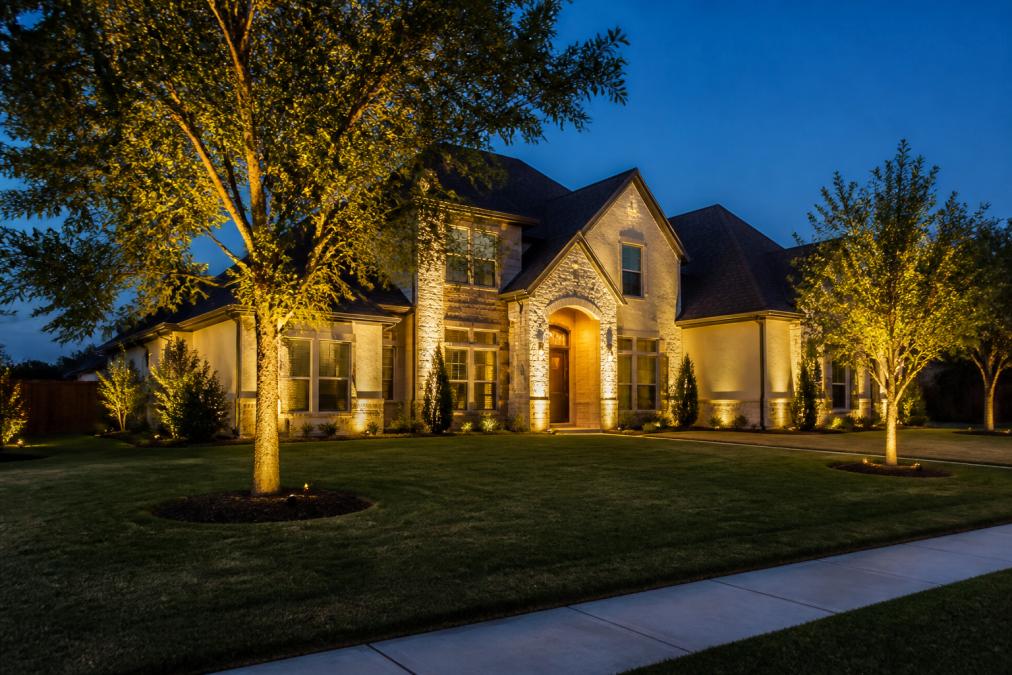
Lighting changes how a home reads after dark, and that impression carries real weight. A property with thoughtful outdoor illumination looks maintained, intentional, and inviting. One with a single porch bulb looks like nobody's home.
The Technical Side: Weatherproofing, IP Ratings, and System Durability
Durability is the difference between a system that still works in year five and one that flickers by year two. The spec that matters most is the IP rating, which grades how well a fixture resists dust and water.
- IP rating: Match the rating to exposure, not the cheapest option available
- Connections: Sealed, gel-filled connectors resist moisture better than bare wire nuts
- Transformer placement: Keep it above grade and accessible for service
- Cable routing: Protect runs from lawn equipment and foot traffic
Cybersecurity and Compatibility: What Most Guides Skip About Smart Outdoor Lighting
Two questions decide whether your system stays useful for years: can it be secured, and will it work with the rest of your smart home ecosystem?
- Change default passwords on every controller and hub
- Put smart devices on a separate network or guest Wi-Fi
- Keep firmware updated when the manufacturer releases patches
- Disable remote access features you don't actually use
Conclusion: Getting the Most from Your Smart Outdoor Lighting Controls
The benefits of installing smart outdoor lighting controls come down to planning: the right fixtures, the right ratings, and a system that talks to the rest of your smart home. Get those right and it runs quietly for years.
Request a walk-through.
Frequently Asked Questions
What are the primary benefits of installing smart outdoor lighting controls?
Smart outdoor lighting controls deliver energy savings through LED technology and automated scheduling, stronger security with motion-activated deterrence, and convenience via remote access from a mobile application. They also improve curb appeal with customizable zone lighting and color temperature adjustments. For homeowners in the Chicagoland area, these systems work year-round, handling everything from holiday displays to everyday landscape lighting without manual intervention.
How do smart lighting controls improve home security?
Smart home security lighting benefits include motion-activated triggers that turn lights on when someone approaches, real-time monitoring through a mobile application, and automated schedules that make your home look occupied even when you are away. Dusk-to-dawn sensors and unpredictable lighting patterns discourage trespassers more effectively than static timers. Zone lighting lets you illuminate specific entry points, driveways, or dark corners without lighting the entire property.
Can smart outdoor lighting help reduce energy consumption?
Yes. Energy efficient outdoor lighting solutions use LED technology that draws far less power than halogen or incandescent bulbs. Automated scheduling ensures lights run only when needed, and brightness control lets you dim output during low-traffic hours. Motion-activated features mean lights stay off until triggered. Combined, these reduce energy consumption significantly compared to traditional always-on systems, and many homeowners see measurable savings on utility bills within the first year.
What are the common downsides of smart outdoor lighting systems?
Potential downsides include upfront installation costs, reliance on stable wireless connectivity, and the learning curve of configuring customizable settings across a smart home ecosystem. Some older systems lack interoperability, limiting which smart hub or voice control platform you can use. Cybersecurity is another consideration: outdoor smart devices should have updated firmware and strong passwords. Working with a professional installer who selects IP-rated, compatible equipment addresses most of these issues before they arise.