
Professional Holiday Lighting Design and Storage Guide
Table of Contents
- Why Professional Holiday Lighting Design Beats a DIY Approach
- The Full-Service Christmas Light Installation Process
- In-Season Maintenance, Repairs, and Timer Settings
- Safe Takedown and Professional Christmas Light Storage Solutions
- Comparing Commercial vs. Residential Lighting Needs
- Permanent Architectural Lighting for Residential Homes
- Energy Efficiency, Cost Analysis, and Sustainability
- Conclusion
- Frequently Asked Questions
Last Updated: September 6, 2026
Why Professional Holiday Lighting Design Beats a DIY Approach
Professional holiday lighting design is the practice of planning, installing, and maintaining custom light displays using commercial-grade materials and safety standards that exceed what homeowners can typically achieve on their own. The gap becomes obvious with a two-story roofline, the electrical load across multiple circuits, or the risk of walking on a snow-covered roof in December.
Many homeowners who attempt DIY installations discover that the initial cost savings disappear quickly. Damaged shingles from ladder placement, burned-out strands from overloaded circuits, and the hidden time cost of untangling lights often eat up the budget. According to Consumer Product Safety Commission lighting safety guidance, indoor and outdoor decorative lighting products are involved in numerous home fires each year, many traced to faulty wiring or improper installation.
This guide walks you through the full-service christmas light installation process, what professional-grade materials and safety standards actually mean, and why professional christmas light storage solutions protect your investment for years.
The Full-Service Christmas Light Installation Process
A professional installation follows a structured sequence that begins weeks before the first light is hung, starting with a site assessment and ending with a safety inspection of every connection and timer setting.
From Custom Design Consultation to Lighting Layout
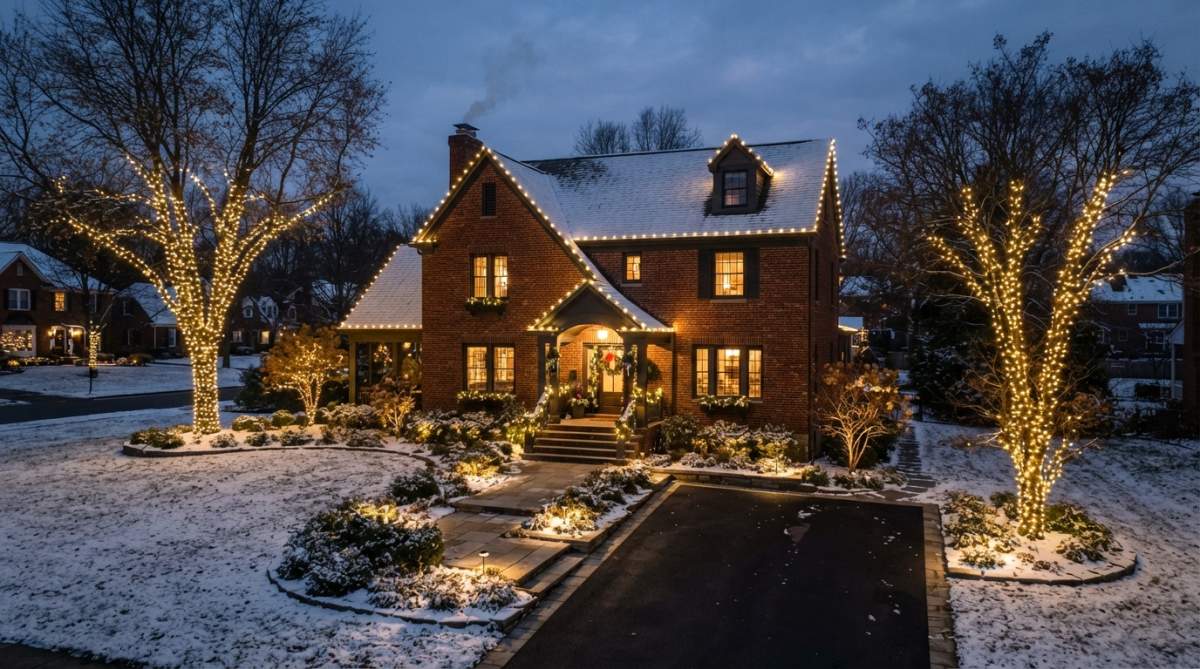
The first step is the consultation, where a designer evaluates your home's architecture, roofline, gutter lines, and landscape features. This produces a lighting layout that maps every C7 or C9 bulb placement, light archway, and twinkling tree before any equipment is ordered.
A common mistake is assuming the design should be symmetrical or uniform. Professional designers instead work with your home's existing architectural rhythm, producing a display that feels intentional rather than cluttered. The layout also accounts for access points, outlet locations, and the electrical load each circuit can safely carry.
Professional-Grade Materials and Safety Standards
Professional-grade materials differ from retail strands in measurable ways: thicker gauge wiring, weather-proof connections, and LED bulbs rated for continuous outdoor exposure. These components survive an entire holiday season of snow, ice, and wind without the flickering problems that plague cheaper systems.
Safety standards govern every aspect of the installation, from the electrical load on each circuit to how clips attach to shingles and gutter lines. A professional team carries liability insurance and follows OSHA-compliant practices for working at height. Occupational Safety and Health Administration fall protection standards require specific equipment and training for residential work above certain heights, which most homeowners do not possess.
In-Season Maintenance, Repairs, and Timer Settings
Professional holiday lighting design includes more than the initial install. A true full-service christmas light installation provides scheduled maintenance throughout the season, keeping the display flawless from Thanksgiving through New Year's.
The maintenance schedule includes a mid-season inspection where technicians check for loose connections, damaged bulbs, and issues caused by heavy snow or high winds. Timer settings are verified to reduce energy waste and extend LED lifespan.
If something breaks mid-season, professional providers respond because they stock replacement bulbs and connectors from the original installation. This responsiveness is a primary difference between a professional service and a one-time installation crew that disappears after the ladder comes down.
Safe Takedown and Professional Christmas Light Storage Solutions
Removal is where many homeowners damage their investment. Pulling staples, yanking cords, and rolling lights into tight bundles can break bulbs and crack insulation. The takedown process is just as methodical as the installation, and the storage that follows determines whether your display survives to see another December.
The Takedown Process: Protecting Your Home and Your Lights
Professional technicians begin takedown in the reverse order of installation, starting with ground-level decor and finishing with roofline elements. Each strand is unclipped using specialized tools, never pried off with a screwdriver or pulled by the wire, preventing damage to shingles, gutter paint, and wiring insulation.
As each section comes down, technicians inspect it for damage. Cracked sockets, frayed wires, and burned-out LEDs are replaced before storage, so the set is ready to hang next season without a separate repair trip.
What Climate-Controlled Storage Actually Means
Many providers claim climate-controlled storage, but the term covers a wide range of facility quality. A professional-grade facility maintains a consistent temperature range, typically between 50°F and 80°F year-round, because extreme heat accelerates insulation breakdown and extreme cold makes wiring brittle. Humidity control is equally important; moisture can corrode copper connections and promote mold growth on fabric-wrapped cords.
Before you hire a provider, ask these specific questions about their storage process:
- Is the facility temperature-monitored? A climate-controlled unit should have a thermostat and a record of temperature consistency, not just a wall-mounted AC unit that runs seasonally.
- Are lights stored off the floor? Palletized or shelved storage protects against flooding, pests, and accidental crushing by other equipment.
- Is the facility pest-managed? Rodents and insects are drawn to warm, dark spaces. Professional facilities use ongoing pest control measures to keep mice from nesting in storage bins.
- Are bins labeled and inventoried? A professional provider catalogs every strand, extension cord, and clip by zone of your property. This inventory system is what allows next year's installation to be faster and more accurate.
The Organizational System Behind Faster Installations
Professional storage is not just about protecting equipment, it is about creating an efficient re-installation process. Each custom display is stored in labeled containers corresponding to specific zones of your property. Extension cords are coiled using the over-under method, which prevents twisting that leads to internal wire fatigue. Clips and mounting hardware are sorted by type and stored separately, so installers do not waste time sorting through mixed bins on a cold November morning.
This system also extends the life of your investment. A professionally stored LED strand can last for many seasons, while the same strand stored in an unconditioned garage or attic may fail sooner due to temperature cycling and humidity damage.
Comparing Commercial vs. Residential Lighting Needs
Commercial and residential holiday lighting projects differ in scale, complexity, and objectives. A residential display focuses on curb appeal and personal enjoyment, while commercial lighting serves brand visibility, customer attraction, and security.
Residential projects typically involve roofline lighting, wrapped trees, and light archways designed to enhance a home's architectural features. Commercial projects for restaurants, offices, hotels, and shopping centers often require larger custom light displays, higher electrical capacity, and lighting layouts that withstand daily public interaction and weather exposure.
The maintenance schedule also differs. Commercial installations often run longer each evening and require more frequent inspections. Restaurant patios and shopping center displays need lighting that creates atmosphere while meeting commercial safety standards and local electrical codes.
| Project Type | Primary Goal | Typical Elements | Maintenance Frequency |
|---|---|---|---|
| Residential | Curb appeal and personal enjoyment | Roofline, trees, archways | Mid-season check |
| Commercial | Brand visibility and customer attraction | Building outlines, parking lot poles, large displays | Weekly inspections |
| Restaurant Patio | Atmosphere and patron comfort | String lighting, accent fixtures | Weekly inspections |
Permanent Architectural Lighting for Residential Homes
Permanent architectural lighting for residential homes offers a year-round alternative to seasonal installation. These systems mount once and provide instant access to millions of colors and patterns through app control, so you can switch from warm white holiday lights to red, white, and blue for the Fourth of July without touching a ladder.
The primary advantage is the elimination of seasonal installation and removal costs. Permanent systems use low-voltage LED lighting designed to last for years, and because the fixtures are professionally installed and weather-proof, they avoid the degradation that affects stored seasonal lights.
A common concern is that architectural lighting will look over-the-top. In practice, permanent systems can be programmed for subtle, natural illumination that highlights your home's architecture without appearing artificial. The fixtures blend into the roofline during daylight hours, maintaining your property's appearance while providing full flexibility for holidays and special occasions.
Energy Efficiency, Cost Analysis, and Sustainability
Energy efficiency is where professional-grade LED lighting separates itself from older incandescent technology. LED bulbs consume significantly less electricity than traditional C7 and C9 incandescent bulbs while producing the same visual impact, lowering your utility bill throughout the holiday season. The difference is a measurable gap that changes the total cost of ownership.
The Real Energy Math: LED vs. Incandescent
To understand the savings, consider a typical residential display with 1,500 bulbs running 6 hours per evening for 45 days (Thanksgiving through early January).
A traditional C7 incandescent bulb draws about 5 watts. At 1,500 bulbs, that is 7,500 watts, or 7.5 kilowatts, per hour. Running 6 hours per night for 45 nights equals 2,025 kilowatt-hours. At the national average residential rate of approximately 16 cents per kilowatt-hour, that display costs roughly $324 in electricity for the season.
The same display using C7 LED bulbs, which draw about 0.7 watts each, consumes just 1.05 kilowatts per hour. Over the same 45-night schedule, that is 283.5 kilowatt-hours, or about $45 in electricity. The LED version saves roughly $279 per season, before you factor in the cost of replacing burned-out incandescent bulbs, which typically fail at a much higher rate.
For larger displays, commercial installations or homes with 5,000 or more bulbs, the gap widens dramatically. A 5,000-bulb incandescent display could add over $1,000 to a seasonal utility bill, while the LED equivalent adds roughly $150. This is why professional installers have largely moved to LED-only installations for both residential and commercial clients.
The Full Cost Picture: DIY vs. Professional Service
The cost analysis for professional holiday lighting design should consider the full picture: equipment purchase, installation labor, maintenance, removal, storage, and energy consumption. When homeowners compare the total cost of buying retail lights every few years, replacing damaged strands, and spending weekends on a ladder, the professional full-service model often becomes more attractive.
A typical DIY homeowner purchasing retail-grade LED lights spends between $200 and $600 for a basic roofline display, depending on the size of the home and the quality of the strands. Those retail lights typically last 2 to 4 seasons before strands fail or connectors corrode, meaning the homeowner repurchases equipment every few years. Add the cost of replacement bulbs, clips, extension cords, and timers, and the recurring expense becomes significant.
A professional installation with commercial-grade materials and climate-controlled storage carries a higher upfront cost, but the equipment is designed for 10 to 15 seasons of use. When the total cost is amortized over the lifespan of the equipment, including the labor savings, the reduced energy bill, and the elimination of replacement purchases, the professional model often becomes comparable to or cheaper than the DIY approach over a decade.
Sustainability Beyond the Bulb
Sustainability also factors into the decision. Professional providers recycle old equipment, use LED technology that reduces energy demand, and minimize waste through proper storage that extends equipment life. Environmental Protection Agency energy efficiency resources highlight that switching to LED lighting reduces both energy consumption and greenhouse gas emissions compared to conventional options.
But sustainability extends beyond the bulb type. Professional installers use reusable mounting clips rather than single-use plastic zip ties or staples that damage shingles. They coil and store extension cords properly, extending their lifespan and keeping them out of landfills. When bulbs do reach the end of their life, many providers participate in recycling programs for electronic components rather than sending them to a landfill.
The Payback Period Question
Homeowners often ask how long it takes for energy savings to offset the cost of a professional installation. The answer depends on the size of the display and local electricity rates, but for a typical residential display, the LED energy savings alone can offset a meaningful portion of the annual service cost. When you add the value of avoided ladder time, reduced injury risk, and the elimination of equipment replacement costs, the payback period can be favorable.
Conclusion
Choosing between a DIY approach and professional holiday lighting design comes down to how you value your time, your safety, and the longevity of your equipment. A full-service provider handles the custom design consultation, professional installation, in-season maintenance, safe takedown, and climate-controlled storage, so the only thing you do is enjoy the display.
Paramount Outdoor Lighting Group brings four specialized divisions under one roof, covering landscape lighting, patio ambiance, holiday displays, and permanent architectural lighting for residential homes. As an authorized JellyFish Lighting Dealer, the team delivers custom designs and professional-grade low-voltage systems that provide instant access to millions of colors and patterns. Request a walk-through and see how a professionally designed holiday display transforms your property by night while preserving its beauty by day.
Frequently Asked Questions
What is included in professional holiday lighting storage services?
Professional storage services handle the entire off-season process. After the holiday season, the installation team carefully removes all lights, clips, extension cords, and decorations from your property. Each item is inspected for damage, neatly coiled or spooled, and labeled by location. The equipment is then transported to a secure, climate-controlled facility where it is protected from temperature swings, moisture, and pests. When the next season arrives, the stored items are retrieved and reinstalled according to your original design plan.
How much does professional holiday lighting design cost?
Pricing for professional holiday lighting design and installation varies significantly based on your property's size, the complexity of the design, the type of lights selected, and your location. For an accurate estimate, request a walk-through. A professional will assess your roofline, landscaping, and power access to provide a custom quote. The total cost typically covers design, labor, materials, maintenance, removal, and storage, making it a predictable annual expense compared to buying and replacing cheap lights yourself.
How do professionals ensure holiday lights look uniform and professional?
Professionals achieve a uniform look through meticulous planning and consistent spacing. They measure rooflines and gutters to calculate exact light spacing, ensuring every C7 or C9 bulb is perfectly aligned. They use commercial-grade clips that attach securely without damaging shingles or siding. The lighting layout is designed before any work begins, accounting for straight lines and symmetrical patterns. Using a single type of bulb and color temperature across the entire display prevents the mismatched, chaotic look common with DIY installations.
Is it better to rent or buy holiday lighting for professional installation?
Renting through a full-service provider is often more practical for most homeowners. The rental fee includes professional-grade LED lights, custom design, secure installation, in-season maintenance, safe removal, and climate-controlled storage for the rest of the year. This avoids the large upfront cost of purchasing commercial equipment and eliminates the need for you to store bulky spools of lights. If a bulb fails or a strand is damaged, the service company handles repairs or replacements as part of the agreement.
How long does professional holiday lighting installation take?
The installation timeline depends on the size and complexity of your property. A standard residential home with roofline and tree lighting is typically completed in one day. Larger properties with extensive landscaping, light archways, or commercial buildings may require multiple days. The process begins with a design consultation to finalize the layout. The installation team then arrives with pre-measured and pre-tested materials, allowing them to work efficiently. Your provider should give you a specific installation window after the design is approved.