Exterior House Lighting Cost & Installation Review
Table of Contents
- Average Cost of Exterior House Lighting Installation
- Landscape Lighting Installation Cost Breakdown
- Factors That Influence Your Total Project Price
- Permanent Architectural Lighting Cost and Long-Term Value
- DIY vs Professional Outdoor Lighting: What You Need to Know
- Types of Outdoor Lighting Systems and Their Price Points
- Maintenance, Warranty, and Long-Term Operating Costs
- Conclusion
Last Updated: August 30, 2026
Average Cost of Exterior House Lighting Installation
Exterior house lighting installation costs vary based on fixture count, electrical complexity, system type, and whether you hire professionals. Most homeowners should budget for both materials and labor, with professional installation ensuring proper design, code compliance, and long-term reliability.
Pricing depends on fixture selection, wiring infrastructure, and whether you're upgrading an existing system or starting fresh. Professional installation ensures code compliance, correct voltage drop handling, and appropriate wire gauge for safety. Cutting corners on electrical work risks flickering fixtures, system failures, or hazards that cost far more to repair later.
At Paramount Outdoor Lighting Group, successful projects balance upfront investment with long-term performance, prioritizing quality materials and expert installation over the cheapest option.
Landscape Lighting Installation Cost Breakdown
Landscape lighting costs break down into fixtures, transformer and control systems, wiring and conduit, labor, and permits or inspections.
Fixtures represent roughly 30-40% of budget. Quality LED fixtures designed for outdoor use cost more upfront but deliver superior longevity and energy efficiency. Pathway lights, uplighting, downlighting, and accent lighting each serve different purposes and carry different price points.
The transformer and control system, the "brain" of low-voltage lighting, typically accounts for 15-20% of material costs. Quality transformers handle voltage regulation, prevent voltage drop across long wire runs, and support smart home integration for app-controlled brightness or color temperature adjustments.
Wiring, conduit, and trenching often surprise homeowners. Running low-voltage wire safely requires proper gauge selection to prevent voltage drop, protective conduit in high-traffic areas, and careful trenching through landscaping. Routing wire around hardscape features increases labor and materials. Proper wire management protects against damage from lawn equipment and weather.
Labor typically represents 40-50% of total project cost, including site assessment, design, fixture placement, trenching, wiring installation, transformer setup, testing, and adjustments. Experienced installers work efficiently while maintaining safety and aesthetic quality. Rushed installation develops problems; quality installation performs reliably for years.
Electrical permits and inspections, where required, ensure code compliance. Permit requirements vary by jurisdiction, so confirming local regulations before starting protects you from costly rework.
Factors That Influence Your Total Project Price
Several critical variables determine whether your exterior house lighting cost falls at the lower or higher end of the spectrum.
Property size and layout directly impact total cost. Small residential lots with simple landscaping require fewer fixtures and less wiring than sprawling estates with multiple zones, mature trees, and extensive hardscape. Larger properties cost more, but cost-per-fixture often decreases at scale.
Site conditions create hidden costs. Properties with rocky soil, dense tree roots, or existing underground utilities require more careful trenching. Sloped terrain increases complexity. Wet or clay-heavy soil may require conduit protection. Professional site assessment identifies challenges before work begins.
Fixture count and type fundamentally shape budget. A modest system with 8-12 pathway lights costs dramatically less than comprehensive architectural lighting combining uplighting, downlighting, accent lighting, and decorative fixtures across multiple zones.
Lighting system type represents a major decision. Low-voltage LED systems dominate residential properties for safety, efficiency, and design flexibility. Solar lighting offers lower operating costs but provides less reliable performance and shorter fixture lifespan. Smart lighting integration adds significant cost but delivers premium functionality.
Electrical infrastructure affects installation complexity. Accessible exterior outlets or existing outdoor circuits reduce integration costs. Properties requiring new circuits or service upgrades face higher electrical costs. Longer wire runs require heavier gauge wire to prevent brightness loss, increasing material expense.
Material quality tiers create substantial price variation. Premium fixtures deliver superior weatherproofing and durability. Budget fixtures often fail within 2-3 years. Mid-range quality typically offers the best balance of performance and value.
Local labor rates vary significantly by region. Urban areas see higher installation rates than rural areas. Spring and early summer typically bring higher labor costs due to increased demand.
Permanent Architectural Lighting Cost and Long-Term Value
Permanent architectural lighting transforms how your home appears after dark while potentially increasing property value. These systems cost more upfront than basic landscape lighting but deliver year-round performance and aesthetic impact.
The IP rating of fixtures, indicating weatherproofing and dust resistance, becomes critical for permanent installations (iec.ch). Fixtures rated IP65 or higher withstand harsh weather without degradation. Lower-rated fixtures deteriorate quickly, requiring frequent replacement.
Warranty coverage typically ranges from 3-5 years for fixtures and 1-2 years for transformers and controls. Quality manufacturers stand behind their products; budget alternatives offer minimal coverage.
LED fixtures consume 75-80% less energy than incandescent or halogen alternatives, dramatically reducing monthly electricity costs (energy.gov). A system costing $2,000 to install might save $200-400 annually in energy costs, recovering the investment within 5-10 years while providing superior lighting quality.
Property value impact from permanent architectural lighting generally trends positive. Real estate professionals note that homes with professional outdoor lighting appeal to buyers and often command premium prices.
DIY vs Professional Outdoor Lighting: What You Need to Know
The decision between DIY and professional installation hinges on electrical knowledge, physical capability, time availability, and risk tolerance. While DIY approaches can save labor costs, outdoor electrical work complexity and mistake consequences warrant careful consideration.
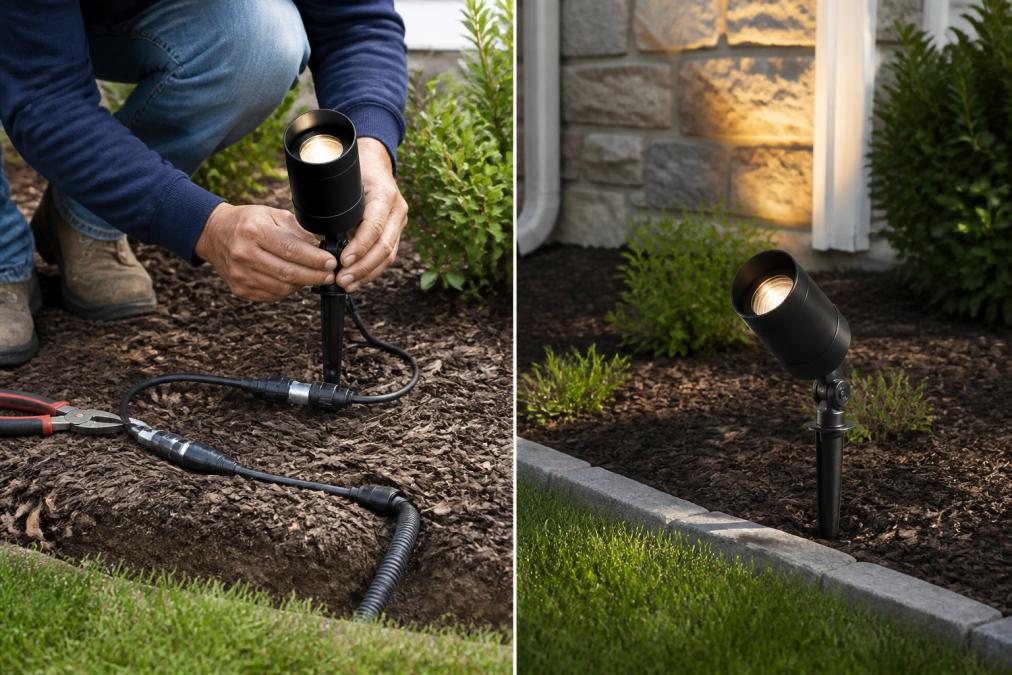
DIY projects work best for simple, low-voltage systems with minimal wiring and straightforward fixture placement. Solar pathway lights or basic plug-in kits avoid electrical complexity but even simple systems benefit from proper design. Haphazard placement creates dark zones, glare, or unbalanced lighting.
Low-voltage systems operate at 12 volts rather than standard 120 volts, making them safer for DIY work (nfpa.org). However, voltage drop becomes a significant technical challenge on larger properties. Calculating correct wire gauge based on circuit length and load requires electrical knowledge many DIYers lack.
Professional installation addresses technical challenges through expertise. Licensed installers understand voltage drop calculations, proper wire gauge selection, transformer sizing, and code compliance. They identify site conditions complicating installation and adjust accordingly.
Safety represents a major consideration. Digging risks hitting underground gas lines, electrical conduits, or water pipes. Professional installers locate utilities before digging and carry liability insurance. Striking a gas line creates financial and safety consequences far exceeding labor savings.
Electrical permits and inspections, required in many jurisdictions, typically demand professional installation. Unpermitted work creates liability issues and complicates future home sales.
Most quality fixture manufacturers warrant products only when installed by licensed professionals. DIY installation voids warranties, leaving you responsible for repairs or replacement.
Professional installers provide design expertise DIYers often lack. Proper fixture placement, appropriate light levels, color temperature selection, and architectural integration create cohesive results rarely achieved through DIY approaches.
Types of Outdoor Lighting Systems and Their Price Points
Understanding different outdoor lighting system types helps you select the approach matching your needs, budget, and long-term vision.
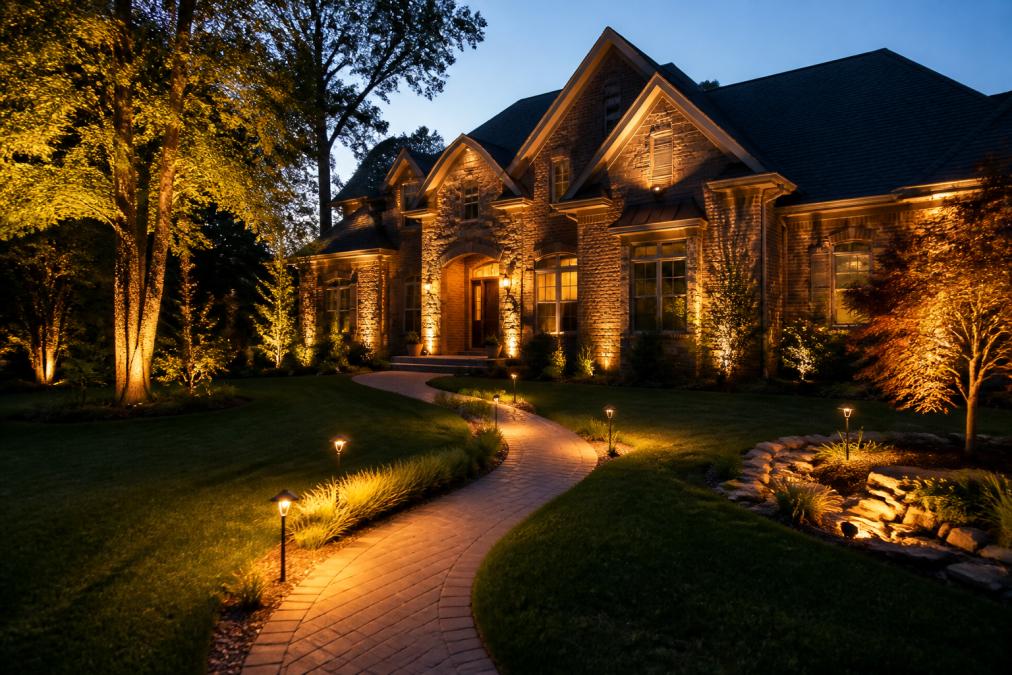
Low-voltage LED systems dominate residential outdoor lighting, balancing safety, efficiency, and design flexibility. Operating at 12 volts through a transformer, these systems eliminate shock hazards and allow flexible fixture placement. LED technology delivers superior efficiency, with most systems consuming 3-5 watts per fixture. A typical system with 12-16 fixtures consumes 40-60 watts total, roughly equivalent to a single incandescent bulb. Low-voltage systems typically cost $1,500-4,000 for comprehensive landscape lighting.
Solar lighting systems appeal to homeowners seeking to eliminate operating costs and avoid electrical work. However, solar systems carry significant limitations. Battery capacity limits brightness and runtime; most solar fixtures provide only 4-6 hours of useful illumination before dimming. Performance degrades in cloudy climates or shaded properties. Battery replacement every 2-3 years adds ongoing costs. Solar systems work well for supplemental accent lighting but rarely deliver consistent performance for comprehensive outdoor lighting. Solar fixture costs range from $15-80 per unit.
Hardwired standard-voltage systems integrate outdoor lighting with your home's main electrical panel, eliminating transformer requirements. These systems power fixtures at 120 volts and require trenching for buried conduit, permits, and professional installation. Standard-voltage systems cost more initially but provide unlimited brightness and runtime. These systems suit permanent architectural lighting on larger properties. Costs typically range $3,000-8,000+ depending on scope.
Smart lighting systems add app control, scheduling, color temperature adjustment, and home automation integration. Smart fixtures cost 20-40% more than standard fixtures but deliver premium functionality. Smart system costs typically add $500-1,500 to basic installations.
Hybrid systems combine low-voltage landscape lighting with selective hardwired architectural fixtures, balancing cost and comprehensive coverage. This strategy optimizes budget by investing in permanent architectural lighting for high-impact areas while using flexible low-voltage for landscape zones.
Maintenance, Warranty, and Long-Term Operating Costs
Understanding full cost of ownership, including maintenance, warranty coverage, and operating expenses, reveals the true investment required for outdoor lighting systems.
Maintenance requirements vary by system type and fixture quality. LED fixtures from reputable manufacturers require minimal maintenance beyond occasional lens cleaning. Low-voltage systems need annual transformer inspection and occasional wire checks. Solar systems require more frequent maintenance, including battery replacement every 2-3 years.
Warranty coverage protects your investment. Quality manufacturers typically warrant fixtures for 3-5 years, transformers for 2-3 years, and controls for 1-2 years. Professional installation preserves warranties; DIY installations typically void them.
Operating costs depend primarily on energy consumption. Low-voltage LED systems consume minimal electricity, adding just $2-5 monthly to your electric bill. Solar systems eliminate operating costs but require battery replacement expenses.
Seasonal maintenance protects system longevity. Before winter, inspect fixtures for water infiltration and ensure drainage holes are clear. In spring, check for winter damage and clean debris. Annual wire inspections identify damage before problems develop.
Long-term replacement cycles should factor into planning. Quality LED fixtures last 25,000-50,000 hours, potentially 10-15 years of nightly operation. Transformers typically last 10-15 years. Wiring lasts indefinitely if properly installed.
A system costing $3,000 initially but lasting 15 years with minimal maintenance costs roughly $200 annually. A cheaper system costing $1,500 but requiring replacement within 5 years costs $300 annually. Quality investments pay dividends over time.
Paramount Outdoor Lighting Group designs systems with durability and long-term value as core principles. Our expertly crafted low-voltage lighting combines quality fixtures, professional installation, and comprehensive warranty coverage, ensuring reliable performance for years while enhancing your property's nighttime appearance.
Transforming your property with professional exterior house lighting requires understanding true costs, both initial investment and long-term value. The complexity of electrical work, importance of proper design, and consequences of installation mistakes make professional guidance invaluable. Paramount Outdoor Lighting Group specializes in custom outdoor lighting design and installation, with decades of experience creating exceptional lighting experiences for residential and commercial properties. Request a walk-through consultation to see how professional exterior house lighting can enhance your property's curb appeal, security, and entertainment potential.
Frequently Asked Questions
Q: What is the average cost to install exterior house lighting?
A: Total costs vary widely based on system type, fixture count, and site conditions. A basic low-voltage landscape lighting system typically ranges from several hundred to several thousand dollars, depending on whether you choose solar, low-voltage, or smart home integration. Professional installation adds labor and electrical permit costs. For an accurate estimate, request a walk-through evaluation to assess your property's specific needs, site complexity, and design goals.
Q: What factors influence the total cost of exterior house lighting?
A: Key variables include the number of fixtures, wire gauge and trenching requirements, voltage drop calculations, fixture quality and material, smart home integration complexity, electrical permits, labor rates, site conditions (hardscape vs. soil), and regional cost variance. Permanent architectural lighting costs more than basic pathway systems. Professional installation ensures proper weatherproofing, IP ratings, and compliance with electrical codes, which protects your investment long-term.
Q: Does professional outdoor lighting installation increase home value?
A: Yes. Well-designed landscape illumination and architectural lighting enhance curb appeal, improve security perception, and extend your property's usable outdoor space into evening hours. Studies show outdoor lighting investments can improve property appeal to buyers and renters. Professional installation ensures fixtures are properly positioned for lumen output, color temperature balance, and long-term durability, maximizing both aesthetic and functional returns on your investment.
Q: Should I install outdoor lighting myself or hire a professional?
A: DIY installation saves on labor costs but requires knowledge of voltage drop, wire gauge selection, transformer sizing, electrical permits, and weatherproofing standards. Professional installation handles site assessment, proper fixture placement for optimal illumination, electrical compliance, and warranty coverage. Professionals also manage maintenance and troubleshooting if flickering or wiring issues arise. For permanent systems or complex designs, professional installation reduces long-term problems and ensures safety on multi-story homes.
This article was written using GrandRanker